
Why do we build homes? Or more simply, why do we make space? Architect and designer Kunal Shah says that while humans create space for shelter, it is also about belonging and a sense of possession.
To explore this idea, Shah has curated ‘Space Making: Making Space’, currently on view at Gallery Art Motif. The exhibition, which opened on March 25 and runs till April 25, features artists, architects, and designers who examine how space is conceived, constructed, inhabited, and reimagined across various physical and social dimensions.

Beyond the usual
Bringing together works across different mediums — photography, textiles, sculpture, and architectural models, the show offers many ways to think about space. It goes beyond the usual idea of buildings and looks at how space is also created through everyday actions, artistic expression, and even relationships between different species. This shift is very important as per Shah.
“Space making is not just about buildings,” he says. “Humans make space for other species, and species make space for each other.” Hinting at the show, he adds, even the act of model-making, of representing space, becomes a form of space-making in itself.
Shared homes
One of the key highlights of the exhibition is a series of photographs showing the work of RMA Architects in developing Hathigaon, a housing project for elephants and their mahouts near the Amber Fort in Rajasthan.
Initiated by the Rajasthan government, the project involved transforming an abandoned sand quarry into a habitat for these animals and their care-takers. The land was rejuvenated to collect rainwater and support plant life, and nearly 20,000 trees were planted to turn the dry site into a green landscape. Housing for mahouts was built in small clusters, using local materials and arranged around courtyards that further extend to outdoor living spaces.
The photographs capture everyday life in Hathigaon—elephants being bathed, children playing in open spaces, and the simple, textured homes of the mahouts. The pictures revolve around themes of communal care and how space here is shared between humans and animals.
Material ways of living
The exhibition also features delicate hanging curtains — chillman and parda—by Uttarakhand-based Japanese textile artist Chiaki Maki that are made using silk and natural dyes like indigo and madder.
The work takes inspiration from the presence of the curtain in Indian homes as an everyday object that has been used for centuries. While offering a sense of privacy, these curtains also filter light, allowing for a soft visibility to the outside.
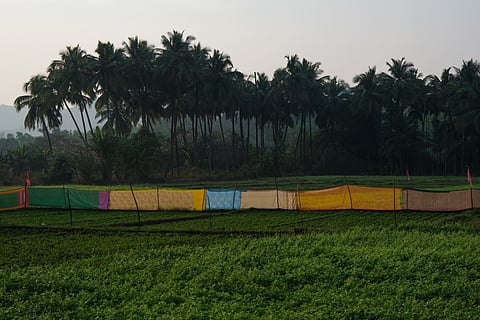
In another series, ‘Do You Have An Old Saree?’, Indrajeet Khambe photographs sarees used as fences in agricultural fields. Stretched across wooden poles, the bright fabrics cut across green landscapes, showing how everyday objects can shape any space meaningfully.
Other works in the exhibition include lime-plastered chini khaanas by Araish Jaipur, sacred decorative halos known as prabhabvalis used in temples, and cotton blinds dyed with water-based colours by Maitreyi Desai. Each work offers a different way of thinking about how space is formed and experienced.
Shah says the selection was guided by how each artist engages with space in their own practice. In a fast-growing urban world, where space is often reduced to property or function, the exhibition urges viewers to slow down and reflect on their surroundings.
“Art gives us a moment to introspect,” Shah remarks. “It makes the act of occupying space more intentional.”
That idea runs through the entire show. Whether it is a saree used as a fence, a woven curtain, or a built structure, ‘Space Making: Making Space’ suggests that space is not just something we construct. It is something we share, shape, and continuously remake.