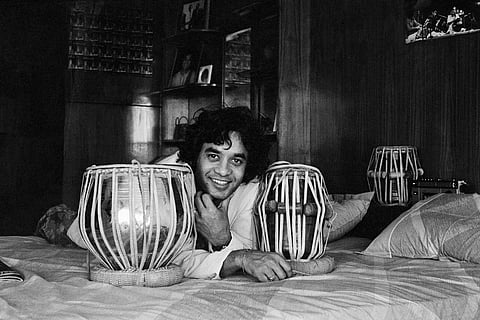

When Ustad Zakir Hussain played, time seemed to stop. Every stroke of the tabla was intentional, every rhythm a universe. This ethos forms the heart of ‘Ustad Zakir Hussain: The Way Forward,’ a three-day festival at Sunder Nursery from March 27-29, curated by MT Aditya Srinivasan, who worked closely with Hussain as a sound engineer, and presented by the Kiran Nadar Museum of Art (KNMA).
Across performances, films, conversations, and an exhibition of Dayanita Singh’s photographs, the festival traces the maestro’s legacy, revealing not just the musician, but the extraordinary person behind the tabla.
Across three evenings, audiences experience performances curated by Hussain’s closest collaborators—Yogesh Samsi, Ranjit Barot, and Anantha R. Krishnan—showcasing traditional tabla compositions rooted in the Punjab gharana, contemporary cross-genre innovations, and the next generation of percussionists carrying forward his vision.
The next generation
Speaking about the festival, Srinivasan emphasises that it is about evolution, not preservation alone. “The beauty of Zakir Bhai was that he took inspiration from every music tradition in the world and turned it into his own. He carried the Indian music world on his shoulders, yet he always encouraged us to find our own identity.” He adds, “The festival captures this through performances by masters who carry forward his traditions, and by inspiring the next generation to innovate while preserving integrity.” Anchoring the festival is a photo exhibition by well-known photo artist Dayanita Singh, who began working with Zakir Hussain as a photographer in 1981 and spent over 40 years capturing his most intimate moments.
She recalls him as a warm and witty person who made everyone feel seen.” For him, every art demanded surrender — to repetition, to discipline, to listening. He believed mastery was not a performance, but a lifelong apprenticeship. “You have to keep learning,” he said. “The day you think you know, you stop growing,” she says.
A ‘listening photographer’
She reflects on the visceral power of his performances: “Watching him perform live was nothing short of electrifying and had a visceral feel which was indescribable. Photography could not always capture the full essence.” Hussain transformed her approach to photography: “He made me into a ‘listening photographer,’ to truly listen to what the other person was telling and not just restrict myself into taking photos.” Her favourite shot remains the first photo she took: “It is a picture of a young Zakir laughing in a carefree manner and it has always been close to my heart,” she says, holding the photograph. The exhibition at Sunder Nursery features around 65-70 photographs. Singh hopes the public gets a glimpse into Zakir Hussain’s personal life and that this serves as a way to carry forward his legacy for generations to come.
“If Hussain was walking tomorrow in Sunder Nursery, he would laugh and tell us to stop this and get on with work,” she adds.
Cinema contributions
Complementing the visual narrative are film screenings, conversations, and a special presentation of Saaz by Chitrahaar Live, led by Pavithra Chari, highlighting Hussain’s contributions to the golden era of Indian cinema. Longtime confidant Mujeeb Dadarkar shares stories of how Zakir Hussain’s tabla lent unforgettable rhythm to films like Heat and Dust (1983) and many others, weaving classical depth into cinematic soundscapes. Drawing from a 30-year association with the maestro, Dadarkar offers audiences rare insights into a life lived fully in rhythm. Srinivasan emphasises that the festival is about community and continuity. “The way for Zakir Bhai’s legacy to survive is to remember his teachings and vision. He always wanted us to bring our creativity, and individuality into music.
‘The Way Forward’ is about sustaining that vision and celebrating the joy of music.”Beyond performances, the festival immerses audiences in Hussain’s philosophy of life as rhythm, where music, discipline, and humanity coexist. Conversations, film screenings, and photographs invite participants to engage with music as an extension of life. Through these mediums, ‘The Way Forward’ creates a holistic portrait of a man whose ideas and rhythms continue to resonate globally today. As Srinivasan says, “This is how we take Zakir Bhai’s legacy forward—for the next thousand years, in every musician who finds their voice.”