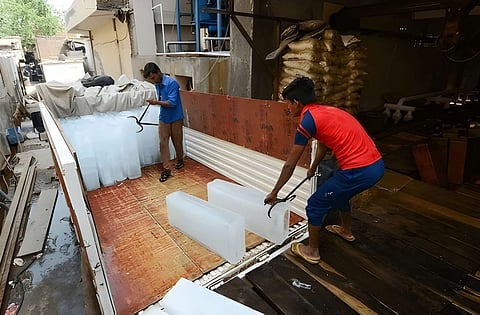

At 7 am in Northwest Delhi’s Inderlok, a truck backs into a warehouse lane. Blocks of ice wrestled off the floor with a pakad - a spiked iron tong - are weighed and put inside a wooden block to slow down the melting.These will then be distributed across Delhi NCR in varying sizes, keeping the city’s summer economy afloat.
Behind every chilled glass of sugarcane juice, every ice-cream bar sold, every gin and tonic poured at a bar is made possible due to the quiet machinery of the ice trade. Though ancient and unglamorous and often overlooked, it remains indispensable to a city where the summers can be harsh.
Abdullah Chaudhary, who runs the distribution arm of Chaudhary Ice Factory out of Shakarpur, inherited the business from his father. The factory sits in Wave City, Ghaziabad, where filtered RO water is poured into steel moulds and left to freeze for thirty-two hours using a refrigeration system that runs on ammonia gas.
“A block of ice takes 20 to 22 hours to fully set,” he explains. The end product, which are finished slabs of 50-60 kg of industrial ice, are then put into wooden boxes and then loaded onto trucks. They are then packed with tarpaulin and insulation to prevent melting of ice during transportation.
The customers are vendors, traders, fishmarkets and construction sites along with households. A kg of ice usually sells for ₹6 to ₹6.50 while a block costs anywhere between ₹550 - ₹600. The price drops to ₹400–450 during winters, when demand is lower. On an average summer day, the warehouse in Shakarpur moves 12 to 14 blocks daily, roughly 700-800 kgs of ice.
A difficult summer
This summer, though, has been uneven. “Weather conditions, rainy season — it has not been so good,” Chaudhary says, with a practised shrug. During summers,demand can spike up to 200-300.This year, sales have remained average due to rains.
Melting of ice is another unavoidable problem.” At least 15-20 percent of each block of ice melts during transportation, this is a trade-off,” Chaudhary says.
“I’ve been working here for the past ten years, hauling ice every single day,” says Rakesh Kumar, 32, a loader at the warehouse. “I earn ₹41,000 a month doing this. I joined this business because I had no other options back then. It’s daily work - lifting, loading, dragging fifty-kilo blocks from the truck, from morning till the work is done. You don’t really think much, you just keep moving,” he says.
For Bhupinder Jadhav who has been selling ice cream and kufi at Connaught Place for years, ice is the lifeline for his business during summer where demand rises nearly by 100%. “ I buy around 80 kgs of ice everyday, break it into chunks and put them in the freezer,” he says.” Without ice, there is nothing to sell.” It is a thin margin business built entirely on the reliability of a supply chain most of his customers never think about.
The right ice
At a Social’s in Hauz Khas, the bar manager, Rohan Pandey, is more particular about his ice than most people are about their spirits.
“We buy tube ice and block ice because they cool faster,melt slowly and are clear - a necessity for cocktails that are consumed slowly.”
His bar goes through close to 40 kg on a busy Friday, sourced from a specialist supplier in Okhla who produces food-grade product using double-filtered water and slow-freeze technology. The price, he notes wryly, is three times what Chaudhary’s ice would cost. “People don’t pay for the ice,” he says. “They pay for what it doesn’t do to the drink.”
By 9 am the last of the morning’s consignments are weighed and loaded onto the trucks at the Inderlok warehouse. The ice trade comes with its own hazards. The physical demand of moving ice every day takes a toll on the body, slip-and-fall injuries are common on the wet, icy floors. The chronic shortage of laborers who know how to use the ‘pakad’ poses another challenge.
“ The new hires work for two, three days and then leave,” Chaudhary says.”Handling ice with a ‘pakad’ needs strength and skill - not everyone can do it,” he says, miming the grip - two hands, angled low with knees bent - the posture of a man who's been in the trade for years.
The warehouse empties as the city wakes up to another summer day. The sugar cane seller is cranking the machine, the juice bar shutter is rolling up and Bhupiner Jadhav starts setting up his shop; all of them are waiting for the ice to arrive. None of it would be cold without the men who moved the ice before dawn. This is Delhi's ice supply chain: invisible, exhausting, and quietly essential.
