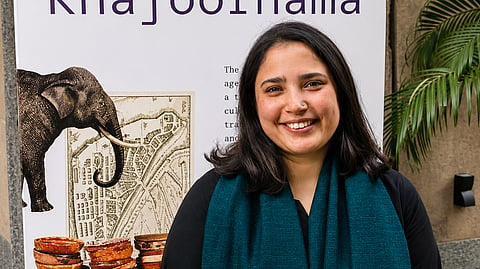

For chef and writer Taiyaba Ali, a bowl of sheer khurma is more than a festive indulgence. It is also a reminder of how an unassuming ingredient can carry the history of communities, migration and memory. The chhuara, or dried date, often overlooked amid the vermicelli and nuts, became the starting point of an unusual exploration into India's food cultures.
The result is Khajoornama, an initiative Ali conceived in collaboration with Delhi-based brand Bruijn. Bringing together food, history, design and storytelling, the project traces the journey of dates across regions and communities, with Delhi's bustling trading quarters and migrant kitchens offering a particularly rich starting point.
“We started with a more general inquiry around dates,” says Ali. “We studied how dates have been present in different communities across the country and mapped how they work with them, in different forms.”
One discovery challenged the familiar assumption that dates are largely imported. They are also commercially cultivated in India's Thar region, where farmers receive government support. Intrigued by the fruit's agricultural and cultural journeys, Ali and her collaborators travelled to Thar, visiting farms and speaking to growers.
Their research eventually found a distinctly Delhi-centred expression at Delhi Art Weekend. Turning the spotlight on chhuara, the exhibition explored how the dried fruit travelled from Sindh to Old Delhi, carried by trade and migration. Khari Baoli, one of the city's historic trading hubs, became central to the narrative.
Rather than relying on photographs and text, Ali brought these histories alive through objects and food. Brass tiffins from Shikarpur, Punjabi kaleeras, stone kharals and Delhi paan daans offered glimpses into the rituals and everyday lives associated with the fruit. Visitors could sample Kharek Samosa with date chutney, date pickle with matthi and Sindhi khoyo, or make their own chhuara-based mukhwas with spices, seeds and aromatics.

“Dates are stereotypically associated with one community. But chhuara is such an Indian subcontinent thing,” says Ali. “To see how it exists ritualistically across communities, and to extend those boundaries, is really interesting. Personal memories and community identification are a large part of what we do.”
The project has also taken the form of immersive tastings, including one at the India Art Fair, where visitors encountered different varieties through a grazing table and bite-sized interpretations of traditional dishes. “People are often surprised to know that dates are grown in India. And then, questions follow about their history, movement, recipes,” says Ali. “We also try to make the experience tactile and participatory, encouraging people to make something themselves that they can take back.”
For Ali, however, the date palm's story does not end in the kitchen. Its motifs appear in Ajrakh, the traditional block-printing practice associated with Sindh and the Thar. Some traditional Muslim wedding rings are also shaped like the fruit and carry names associated with it. Khajoornama hopes to investigate these connections further, looking at the palm's presence in crafts, textiles and jewellery.
The larger ambition is to create a public-facing archive of the social history of dates, documenting recipes, agricultural practices and personal narratives. The collaborators are also exploring possibilities in other regions, with conversations underway in Bengal around date palm sap, nolen gur, crafts and textiles.
“It is a fully fluid and evolving project,” says Ali.
For now, Khajoornama remains largely self-funded. Some public events are ticketed, usually between Rs 800 and Rs 1,000, while the collaborators are exploring grants, scholarships and fellowships to sustain the initiative.
“We don’t do it for money,” says Ali. “But we are looking for ways to sustain ourselves. We will keep finding a way to keep the conversations around dates going.”
In a city like Delhi, where generations of traders, migrants and communities have carried their food traditions into its kitchens and markets, Ali's project offers an invitation to look again at something familiar. Sometimes, a little chhuara is enough to open up an entire history.