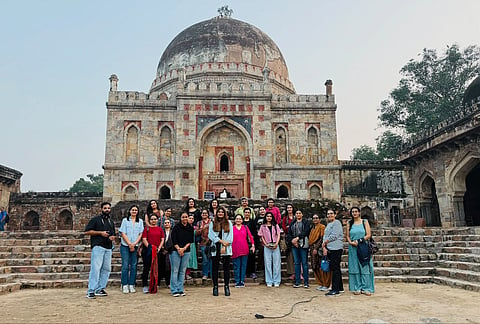

The sight of 40 women walking through a historic monument after sunset is unusual enough to turn heads. For historian and academic Anoushka Jain, however, it is precisely the sight she wants Delhi to get used to. Since 2022, she has been organising women-only night heritage walks, encouraging women to explore the city after dark, one monument at a time.
The idea emerged after Jain, founder of Enroute Indian History, began receiving calls from women who wanted to join her evening walks but were unable to participate in mixed-gender groups because of restrictions at home. She saw an opportunity to create a space where women could experience the city's heritage without feeling uncomfortable or constrained.
Founded in 2019, Enroute Indian History aims to make academic history accessible through engaging storytelling. “I always wanted to bridge the gap between academic history and popular history,” says Jain.
The women-only walks, usually held between 5 pm and 7 pm, take participants to monuments such as Safdarjung Tomb, Qutub Minar, Sunder Nursery and Lodhi Garden. The timings are planned to allow everyone to return home by 8 or 8.30 pm. The guides, organisers and content creators are all women, creating an environment that encourages participants to explore together.
“Seeing only women around you makes a difference. It gives many participants a sense of comfort and confidence,” says Jain.

The walks attract women from across Delhi-NCR, including Meerut, Faridabad, Ghaziabad, Noida and Gurugram. Each walk typically sees 30-40 participants, and the organisation estimates that 500-1,000 women have taken part since the initiative began. The guided walks are free, although participants pay for monument entry tickets wherever applicable.
For Suchitra, a Delhi-based working professional who has participated in two walks in 2025 and 2026, the experience has changed her relationship with familiar public spaces. “I feel proud to reclaim these places alongside other women. It gives me a sense of confidence and empowerment,” she says.
The walks also create opportunities for friendships. Participants exchange numbers, make plans for future visits and sometimes arrange to travel together. Jain says registrations regularly come through social media, while the sight of large groups of women exploring monuments at night continues to surprise passers-by.
Safety remains an important consideration. Questions about parking, security personnel and the surroundings are factored into the planning of each walk. But Jain believes these concerns should not become reasons for women to miss out on experiencing their city.
“Monuments look incredibly beautiful at night. Why should women miss out on experiencing their own city?” she asks.
For Jain, the larger purpose goes beyond heritage tourism. It is about questioning why women's access to public spaces should be dictated by the setting sun. “Why should we have to go home as soon as it gets past 6 pm? Women should also have the freedom to explore their city after dark,” she says.