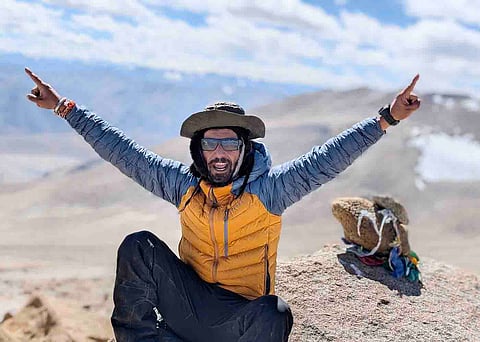

Mountaineer Sachin Gangta who belongs to Kathasu village in Jubbal, Shimla, has completed an ambitious 21-day high-altitude expedition in Ladakh, scaling 25 peaks above 6,000 metres across the remote Changthang region between 10 and 30 September 2026.
Named Project Changthang, the expedition saw Gangta and his guide and climbing partner Padma Namgayal complete all 25 summit ascents. Over 21 days, the duo covered more than 200 kilometres, spent 16 days on summit climbs and recorded a cumulative elevation gain of more than 18,000 metres. Their highest camp was established at approximately 5,560 metres, as they moved through some of Ladakh’s most remote and demanding mountain terrain.
For Gangta, however, the number 25 was more than a mountaineering target. Born on 25 February 1990, he chose 25 peaks as the defining objective of the expedition, turning a demanding high-altitude challenge into a personal tribute to his own journey and roots.
“I come from a place where the mountains are part of who we are. For me, this expedition was never just about counting summits. I wanted to take something personal from my place and carry it into the high mountains of Ladakh. When you are standing above 6,000 metres, the number stops being important; what matters is whether you have the strength, discipline and humility to take the next step,” says Gangta, founder, Himalayan Gypsie.
A tribute to Nirmal Purja
Project Changthang was also undertaken in memory and inspiration of Nirmal Purja, popularly known as Nims Dai. Gangta has drawn inspiration from Purja’s approach to high-altitude mountaineering and his determination to take on demanding challenges in some of the world’s highest mountains.
The expedition took the climbers across Changthang, one of Ladakh’s highest and most remote regions, with an average elevation of around 4,500 metres. The prolonged exposure to altitude, extreme cold, strong winds, low oxygen availability and difficult terrain made acclimatisation, recovery and decision-making as important as physical endurance.
Among the highest points reached during the expedition were Chalung North at 6,405 metres, Pologonka at 6,390 metres, Spangnak Kangri North at 6,380 metres and Spangnak Kangri at 6,370 metres.
Unlike a conventional mountaineering expedition built around a single major summit, Project Changthang was conceived as a continuous sequence of climbs across multiple peaks, requiring the climbers to repeatedly ascend, descend, recover and prepare for the next summit. Sixteen of the 21 days involved summit climbs, requiring the climbers to repeatedly manage acclimatisation, recovery, hydration, nutrition and equipment while moving through remote and demanding terrain.
‘Not to defeat a mountain’
“There were moments when the mountains made us slow down, and that is when you learn that mountaineering is not about defeating a mountain. It is about understanding when to push, when to wait and when to respect the conditions. The biggest achievement for me was not reaching the 25th summit; it was making the right decision on every mountain and returning safely,” Gangta said.
