
Before there is a goddess, there is the sound of her. A few days ago in Chittaranjan Park, Delhi’s Bengali heartland, I heard a dhak being tested somewhere behind the bamboo scaffolding, its rolling thunder carrying down lanes still strung with half-finished stalls. Marigolds hung in heavy bundles. The air already smelt faintly of frying.
Today, Durga Puja begins, and the neighbourhood has been waiting for it. Children darted between the bamboo poles, shouting over one another. Volunteers argued cheerfully over where the lights should hang. Somewhere nearby, a conch shell was tried out, and the whole lane seemed to pause for a breath before going back to work.
The real feast is not on the lanes but behind the pandals, where the kitchen committees of the Pujo Samitis gather to cook the pujo’r bhog. Giant pots of runny khichuri bubble away, stirred with ladles nearly as long as the cooks’ arms. Begunis arrive piping hot. There is labra, and sweet chaatni to follow. Over it all, chants of “Joy Maa Durga!” rise like steam, lifting the spirits of the volunteers running the show.
“The bhog is not just any meal, it is a feeling,” said Sanjukta Chakrabarti, a Noida resident and member of one of the Pujo Samitis. “It tastes divine, and that probably is owing to the energy and the atmosphere that it is cooked in. It is prasad, nourishing and assuring.”
Out on the street, snacking is its own tradition. A caterer from Market No. 2, a fixture of the area, ran me through his jolkhabar lineup: Kolkata rolls, dimer devil, veg chops, mutton chops, singhara, ghugni, beguni and aloo chop. It is the kind of list that sends a Bengali homesick and a Delhiite hungry. A local jhalmuri vendor has teamed up with him, so cones of puffed rice, tossed with mustard oil and a squeeze of lime, will be shaken together for the crowds.
Bengal is also travelling well beyond the pandals. Ayandrali Dutta is hosting a pujo pop-up at Barbeque Nation in Saket, and is also helping with the bhog and organisation at Durgotsab in GK-2. For something more luxe, Chef Kaushik Misra and his team at Taj Mahal, Delhi, have prepared a festive feast. In Connaught Place, Kolkata’s Anindya Basu and Madhushree Basu have curated a festival at The GT Road.
Yet this is only one half of the city’s table.
Navratri began Monday, and for many Delhiites it means the opposite of feasting. Twice a year, as spring tips into summer and as autumn gives way to winter, people fast through Chaitra and Sharad Navratri. The belief is that the body’s immunity dips as the seasons turn, and that setting grains aside for a fruit-based diet readies it for what follows. This year, with temperatures dropping early, the change feels sharper than usual.
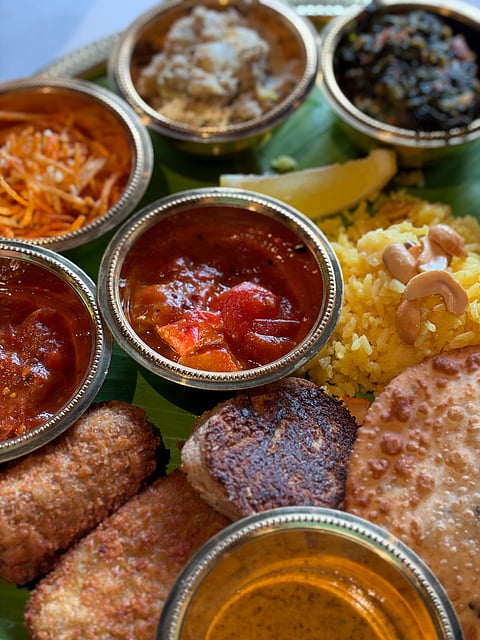
The fasting plate has its own comforts: kuttu puris, sabudana khichdi, potatoes seasoned with rock salt, bowls of fruit and cool curd. Restaurants have responded in kind. No-onion, no-garlic Navratri thaalis are flooding menus across the city, aimed at those observing the fast, even as Bengali thaalis go out to the pandal-hoppers.
That is Delhi: a cultural hotpot that fasts and feasts in the same week, sometimes on the same street, sometimes at the same table. One family may keep a fruit fast at home and queue for khichuri at the pandal by evening. Both are acts of devotion, and both end the same way, with food shared and the goddess honoured. Whether you are fasting or feasting, she seems to have made room for you at her table.
