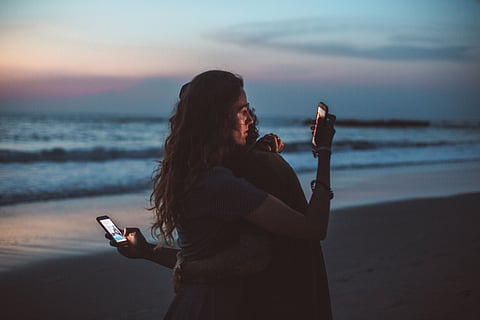

There was a time when being away meant switching off. You could step out with friends or make time for yourself without feeling the need to tell anyone. Today, even when we are not posting, we are still online — liking, replying, reposting, scrolling and watching.
For journalism student Rahul, social media has become difficult to step away from because of how quickly information travels online. “Social media has become one that really gets you that information right at that point,” he says. For those trying to build a professional identity online, he believes the pressure is even greater. “Sometimes there are some things where you just don't want to tell everything, but you have to because you have a brand to build,” he says.
The 30-degree version
Being online does not always mean actively posting. Even when a person is not putting up a story, they may still be liking posts, replying to stories or reposting content. Rahul describes social media as a space where people carefully select which parts of their lives others get to see.
“You can just remove those things and put out a story... you just want the people to see the 30 degrees,” he says, contrasting it with the “360” of real life. Even when his room is messy, Rahul says he can simply frame a well-decorated wall for his Instagram story. “I will just put out a story of how beautifully it is decorated and get 20-50 likes,” he says.
Anushka Gupta, a PR professional in Mumbai, believes influencer culture has led to this pressure. With influencers constantly sharing their lives online, younger users and budding creators can feel compelled to do the same. “They feel the constant urge to post their lives online to get validation from people,” she says.

When the moment becomes content
The pressure does not always begin after a photograph is taken. Sometimes, it enters the experience itself. Going out with friends can mean thinking about the right photograph, lighting or angle before actually enjoying the moment. Rahul says that when people begin imagining how an experience will appear online, the offline experience becomes distracting. “If I took this picture in this angle, should I take that picture in that angle? What kind of lighting should I take?” he says.
For Gupta, this pressure became particularly noticeable during the COVID-19 period, when Instagram trends were everywhere. She remembers feeling that if something was trending, she had to shoot it, edit it and post it before the moment passed. “It’s a constant pressure that I’m posting this. It’s not that bad because my friends have given me that validation, but why is it not going up?” The numbers, likes, views and comments add another layer to that pressure.
Audience awareness
Unlike a conversation with a friend, social media comes with an audience that can be difficult to define. Friends, acquaintances and strangers can all be watching the same post.
Aswin Raj, who works at a bank in Bengaluru, says he does not post much on social media. Yet he has noticed that people can interpret his absence online as a sign that something is wrong. He believes the expectation to share has created a prejudice against those who choose to remain less visible
Gupta believes that when people constantly feel watched or judged, they tend to show only the best parts of their lives. “You present only the best versions of yourself online, and that is mostly fake,” she says. She believes people often show the dreamy parts while leaving out the difficult days.
For Anjali Kumari, a 20-year-old student at University of Delhi, social media has introduced her to new hobbies, places and perspectives. But she says it has also made her feel “lonely and undeserving and inferior” at times. She believes constant comparison can make young people focus on proving themselves all the time.
Yet the experience is not universal. Param Singh, a 19-year-old student from Delhi, says he does not generally feel pressured to appear successful or attractive online. For him, Instagram is primarily a way to stay connected and discover new things.
Finding an off switch
The difficulty, perhaps, is not simply that people spend time online. It is that there is increasingly little distinction between being online and being available. A person may not be posting, but they are still expected to see a message. For those building careers or identities online, stepping away can feel like falling behind.
Rahul describes the constant cycle of posting, replying, creating and collaborating as exhausting. Having some space away from it, he says, could give people time to reassess what they are doing and avoid burnout.
Perhaps the challenge is not learning to disappear from social media entirely, but learning that we do not have to be visible all the time. Not every outing needs a story. Not every good day needs an audience. Not every moment needs to be photographed from the right angle. Sometimes, being present simply means letting the moment exist without asking how it will look online.