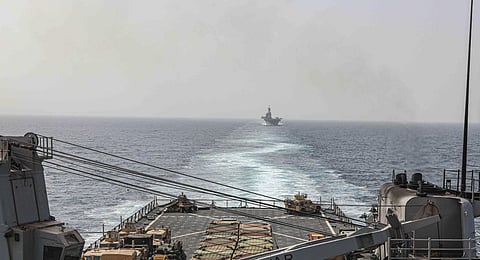

Months after intense diplomacy to avoid the ongoing Israeli-Hamas conflict spilling across West Asia and beyond, the US ended up doing exactly what it set out to avert. A spate of attacks on cargo shipments in the Red Sea through missiles and drones by Yemen’s battle-hardened Houthi militia —in an act of solidarity with the Palestinians —forced the US and the UK to bombard the militia’s military installations. With the Houthis vowing revenge, a new battlefront has just opened. The Houthis are an Iranian proxy, as are the Hamas and the Hezbollah, so their mutual kinship was expected. By militarily engaging the US, the militia appears to be gaining a newfound sympathy and respect in the region. Trouncing the Houthis through superior firepower is impossible, as Saudi Arabia learnt at its expense. A Saudi-led coalition that sought to stop Houthi advances in Yemen, led to a humanitarian disaster with over 1.5 lakh people dead. The Saudis were left bruised with sporadic drone and missile attacks on their oil industry. Riyadh was forced to change tack, opening peace talks with Tehran and truce with Sanaa. It has now sought to build distance from the US-UK attacks. The Biden administration had curiously lifted the Houthis from its list of foreign terror outfits in 2021, a status it continues to enjoy.
Hours before the strikes, US Secretary of State Anthony Blinken called up foreign minister S Jaishankar to keep him in the loop. Jaishankar said he appreciated Blinken’s insights on the situation in West Asia—code for the eventual pounding of Houthi targets. A suspected Houthi drone strike on an India-bound oil shipment off the Gujarat coast in the Arabian Sea drew the country into the conflict vortex. The Indian Navy is the pre-eminent naval power in the region. It has already started policing critical Arabian Sea lanes, including the Somalia-Yemen chokepoint in the Red Sea. Many merchant ships across the world have Indians as part of their crew, so the country cannot take its eyes off the situation. Rerouting cargo away from the Red Sea is bleeding global economics and adding to inflation.
While vigilante attacks on shipping lanes cannot be condoned, they draw sustenance from the conflict that has already killed thousands of Palestinians and displaced the entire Gaza populace. Getting to end the disproportionate retaliation against Hamas could be a good starting point for restoring peace
