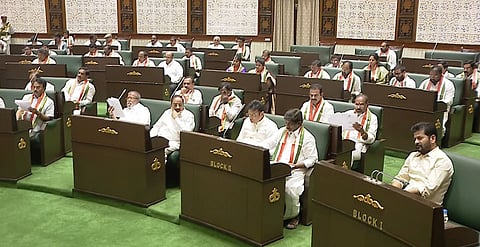

Hair-splitting arguments on constitutional matters are unavoidable most of the time, but in some cases, such as the roles of the speaker of a legislative assembly or the chairman of a legislative council and the governors, they are surely unnecessary. For, in the public psyche, the morality of their action or inaction is so glaring that its legality becomes secondary. The recent Supreme Court verdict that set a deadline of three months for the Telangana assembly speaker to decide on the disqualification pleas against 10 MLAs of the Bharat Rashtra Samithi (BRS), who switched allegiance to the ruling Congress, falls into this category.
The legislators defected after the elections in December 2023, and petitions for their disqualification have been pending with the speaker for over a year now. In between, a single-judge bench of the Telangana High Court directed that the petitions be placed before the speaker to fix a schedule for hearing within four weeks, but then, on an appeal, a division bench of the court set aside the order, prompting the BRS to move the Supreme Court. The judgement of the apex court is another reminder for a relook at the anti-defection law enacted in 1985 to see that the aaya ram gaya ram culture doesn’t undermine our democracy. Drawing from different verdicts over the decades, such as the Kihoto Hollohan vs Zachillhu and others, and Keisham Meghachandra Singh vs Speaker of the Manipur Assembly, the apex court held that the speaker must decide on disqualification within a reasonable time. In the Telangana case, the speaker did not issue even notices for over seven months. The court further suggested that parliament reconsider whether the speaker should be the one deciding on members’ disqualification.
This is an important point that we must pay heed to. The speaker, by virtue of being elected by the ruling party members, may not—and history is evidence that they did not in many cases—act impartially. This means only one thing: the anti-defection law’s objective stands practically defeated. All political parties, in power or opposition, are responsible for this. The only way to bring fairness and uphold the will of the people is to ensure that the speaker of the Assembly is non-partisan and above party politics when adjudicating on the disqualification of legislators. The sooner it is done, the better.
