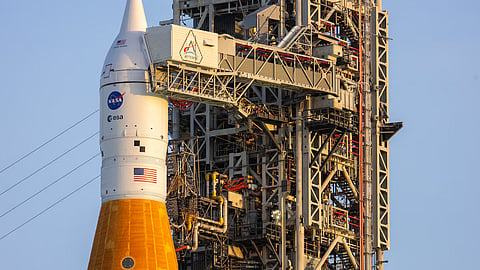

Precisely 53 years, three months and 14 days after the last human returned from landing on the Moon during the Apollo 17 mission, Nasa launched the 10-day Artemis II crewed mission, marking a historic attempt to return humans to the lunar environment. However, Artemis II will not land on the Moon. It will instead be a flyby mission. It will, however, set a record for the farthest distance humans have ever travelled into space, as the Orion capsule—carrying four astronauts, Reid Wiseman, Victor Glover, Christina Koch and Jeremy Hansen—will travel about 6,400 km beyond the Moon, a feat no Apollo mission attempted. Artemis II will form a loop beyond lunar orbit to achieve this distance.
Of the 24 US astronauts who travelled to the Moon or its vicinity between 1968 and 1972, 12 walked on the lunar surface. All were men and part of the six crewed Apollo missions that landed on the Moon. Artemis II, however, will carry the first woman astronaut (Koch) and the first astronaut of colour (Glover) into the vicinity of the Moon—indeed, the first time either will travel beyond low Earth orbit.
Artemis II is not just a symbolic trip. What matters most is what it can prove—or fail to prove. The Orion spacecraft must demonstrate that it can sustain astronauts far beyond Earth’s orbit, with systems that provide air, water and a safe living environment. Its heat shield must also withstand the extreme speed and heat of reentry into Earth’s atmosphere. At the same time, the Space Launch System will undergo its first real test carrying a crew, where safety cannot rely solely on calculations and assumptions but must be proven under real conditions. A key experiment on the mission, AVATAR (A Virtual Astronaut Tissue Analog Response), will measure the effects of radiation and microgravity on the human body.
The mission represents the first step in an ambitious plan to establish permanent lunar bases while laying the groundwork for crewed missions to Mars and beyond. Other, less obvious tests are equally important: the crew must navigate with reduced support from Earth and continue operations despite communication delays. Under the Artemis programme, this mission will determine what comes next. If it succeeds, it will validate an entire exploration architecture.
