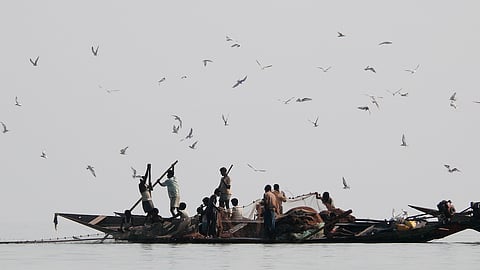

The Union ministry of environment, forest and climate change’s in-principle approval for the proposed international airport in Puri is unsettling on several grounds. The decision speaks volumes about the development priorities of governments and how little they care about the country’s fragile ecosystems. The ₹5,631-crore Shree Jagannath International Airport project received first-stage approval earlier this month to re-purpose 27.9 hectares of forest land. The nod came amid concerns over the choice of the project’s site—16 km from Puri and 14 km from the Chilika lagoon. The project, which requires 471.4 hectares in all, is also close to the Balukhand-Konark Wildlife Sanctuary. Several inspection reports in the run-up to the clearance had pointed at the site’s proximity to olive ridley turtle nesting grounds, dolphin migration routes and the Central Asian Flyway. The flyway, which brings more than 150 species of migratory birds to Odisha, can pose a serious threat of bird-hits.
With the ecological challenges stacked up, the Odisha government asked the Wildlife Institute of India for its views. After inspecting the site last year, the institute’s team of scientists offered two options. The first was to reject the project on two grounds—its proximity to Chilika, a wetland of designated international importance, and the location of the Bhubaneswar airport merely 65 km away. The team cited the example of the Muan International Airport in South Korea, situated 9 km from another Ramsar site, where a bird-hit incident in 2024 claimed 179 lives. The institute’s other option involved a series of mitigation measures and impact assessment studies should the government consider the project unavoidable. It recommended that the studies be completed before granting statutory clearances.
One must consider the region’s broader development plans, too. Apart from the airport, a coastal highway under the Bharatmala project is also planned here. The airport, which has been proposed to start with the capacity to handle 4.6 million passengers a year, is expected to be expanded to process 16 million in 20 years. The water it would require and waste it would generate have been barely assessed. The ecological burden will be felt by Chilika, Asia’s largest brackish-water lagoon. Infrastructure projects that extract such massive ecological costs must be reviewed. Myopic development is not an option.
