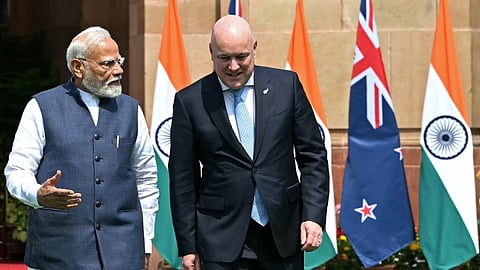

The free trade agreement signed between India and New Zealand on Monday aims to double bilateral trade to over $5 billion annually. Concluded in just five rounds over nine months, it is among the fastest trade deals India has negotiated. While New Zealand is a relatively small trading partner, the pact is significant—not merely for diversifying options amid global economic uncertainty, but for the template it offers.
The agreement eliminates duties on all Indian exports to New Zealand, which were valued at $711 million in 2024–25. It opens opportunities in labour-intensive sectors such as textiles, leather and jewellery. Wellington has also committed to invest $20 billion over 15 years and to facilitate temporary employment for skilled Indian professionals, with up to 5,000 three-year visas annually.
In return, New Zealand will secure zero-duty access for around 70 percent of its exports. Its farm sector stands to gain from duty-free exports of wool, wood and fruits such as avocados and blueberries, while wines and spirits will see phased tariff reductions over a decade. Crucially, India has safeguarded sensitive sectors—especially dairy, along with items such as onions, peas, almonds and most meat products—reflecting a calibrated approach.
Trade negotiations with larger partners—the European Union, the UK and the US—have often proved protracted and contentious. Talks with the EU have stretched over two decades, while a deal with the US remains elusive. Large economies typically seek deep access to India’s market even as non-tariff barriers constrain Indian exports.
Against this backdrop, the New Zealand agreement stands out for its speed, clarity and balance. India’s recent trade strategy—seen in agreements with Mauritius, the UAE and Oman—suggests a deliberate pivot towards smaller, developed partners where mutual gains are easier to structure.
This is a pragmatic path. Such agreements may not deliver headline trade volumes immediately, but they build resilient economic linkages and reduce overdependence on dominant powers. Over time, a network of well-crafted FTAs with like-minded economies can offer India both strategic flexibility and greater leverage in an increasingly polarised global trade order.
