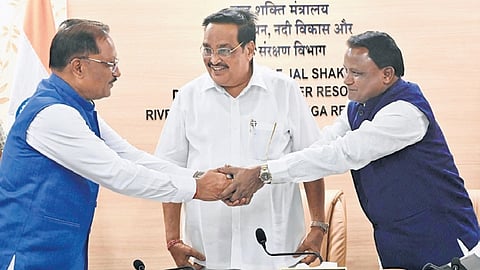

Last week, Jal Shakti Minister C R Patil convened a meeting in New Delhi where Odisha Chief Minister Mohan Charan Majhi and his Chhattisgarh counterpart Vishnu Deo Sai concurred on an amicable resolution of the Mahanadi river water dispute in the next 3-4 months. Going by Majhi, the matter should be closed by Diwali. He went on record stating that Odisha’s position was “articulated firmly and unequivocally” and was hopeful of the dispute ending with the cooperation of both riparian states. If that happens, it would mean dialogue prevailing over litigation in one of eastern India’s most contentious water-sharing conflicts.
The dispute erupted in 2016 when Odisha flagged concerns over the construction of six industrial barrages upstream of the Hirakud dam on Mahanadi, which it said would affect downstream flow. The lower riparian state expressed apprehensions that lower non-monsoon flows would have major consequences on the ecologically-sensitive coastal and deltaic regions inhabited by lakhs of people.
Chhattisgarh had asserted that, as the upper riparian state, it was within its rights to use Mahanadi water in upper catchments. The Centre intervened, but a meeting convened by the then Jal Shakti Minister Uma Bharti yielded no result. It prompted Odisha’s BJD government of the time to knock on the doors of the Supreme Court. The Mahanadi Water Disputes Tribunal was constituted in 2018, but the issue dragged on for another six years.
However, things seemed to click into place in 2024, when with the change in government in Odisha, both states came under BJP rule. Majhi took the initiative towards an acceptable resolution and the neighbouring state accepted the plan. After a nudge from the tribunal this year, the negotiations picked up pace and the two sides agreed not to contest at least 15 issues.
A mutually-agreed settlement backed by hydrological evidence and institutional support can be more successful than one imposed through litigation. That is the bigger lesson from this episode. India has witnessed protracted disputes over the waters of Cauvery, Krishna and Ravi rivers, where legal verdicts have failed to overcome political distrust. If the Odisha and Chhattisgarh governments can build on the political unanimity to ink a transparent and legally durable agreement, the Mahanadi resolution has the potential to emerge as a model of cooperative federalism that others can emulate.
