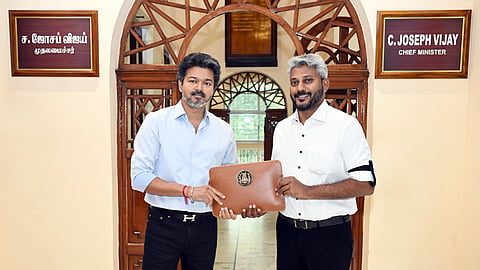

The debut budget of the Vijay-led TVK government in Tamil Nadu, unveiled amid high expectations, has focused on youth and women. Mindful of the state’s growing debt and revenue challenges, it has consciously avoided big-bang announcements. At the same time, it has sought to expand the scope of social welfare measures.
The proposals to gift an 8-gram gold coin to every bride and a 1-gram gold ring to every newborn delivered in a government hospital use the amber metal to provide a safety cushion at pivotal life moments, scheme titles such as Annan Seer Thittam (Brother’s Wedding Gift) and Thai Maaman Thanga Mothiram Thittam (Maternal Uncle’s Gold Ring Scheme) reflect a patriarchal approach. At the same time, the plans for maternity care centres for pregnant women across the state and shelter homes offering counselling and rehabilitation support to transgender persons have won the hearts of many. Even when prioritising long-term investment in education and infrastructure, the government has not abandoned populist welfare. Although enhanced social security and free laptops for college students, an essential learning resource today, dominated the budget, it also bats for strengthening public infrastructure through school modernisation, digital libraries, integrated student hostels and skill development programmes. Vijay has made education a clear priority, with the budget allotments including a ₹2,132-crore scheme for infrastructure improvement at 3,734 schools and providing over 5.3 lakh high-school students with bicycles and helmets.
What remains to be revealed is how the government will boost its revenues. The budget mentions various reforms that are expected to generate an additional ₹15,000 crore. The white elephant of the state electricity board’s debt must be tackled through a gradual tariff hike. Tax leakage in liquor retail needs to be plugged with a more robust enforcement and monitory system.
This government has claimed that the outgoing one’s interim budget had inflated infrastructure project costs, and has reduced the capital expenditure allocation for 2026-27 in the revised estimates. Despite this, the state’s outstanding debt, projected to rise to ₹11.12 lakh crore by the end of the fiscal year, remains a major concern, even though the burden as a share of revenue receipts has slightly declined. It would not be a surprise if the government deploys other means sometime soon to enhance revenues as it seeks to increase capital expenditure and fulfil its electoral promises.
