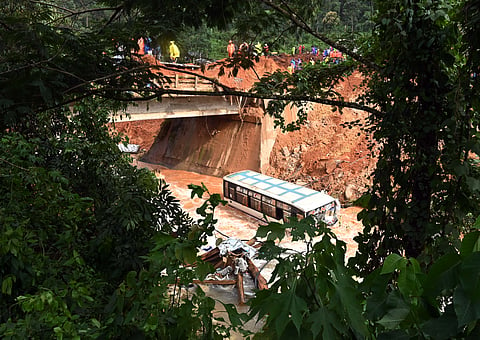

Another monsoon, another tragedy. The disturbing consistency with which rain-linked disasters recur in Kerala is deeply unsettling. Yet no lessons seem to have been learnt. Tuesday’s deadly landslip at a road tunnel project in Wayanad appears to be partly a man-made disaster. So far, three people have been confirmed dead, while seven remain missing. The incident has exposed shocking apathy, criminal negligence, blatant violations and a complete disregard for human life. Reports say the area received over 200mm of rain in 24 hours, in an already fragile landscape. But the scale of the disaster was worsened by huge mounds of excavated soil left at the worksite. When part of a rain-soaked hill gave way, the rushing water and mud swept away the loose earth, burying the worksite and causing widespread damage nearby. The landslip may have been natural, but the devastation was not.
Soon, a blame game began. The Kerala government accused the contractor of ignoring repeated directions to remove the excavated soil. The contractor and Konkan Railway, the implementing agency, insisted that the heavy rain triggered the collapse. Meanwhile, the state government ordered two investigations, one into the tragedy and another into possible violations during tunnel construction. The project’s environmental clearance included strict conditions. While serious lapses in execution are evident, the failure of regulatory oversight is equally obvious. Given Kerala’s experience with rain disasters, authorities should have been far more cautious before allowing tunnel work during the peak monsoon season. The government’s responsibility did not end with issuing warnings. If officials recognised the danger, the contractor should have been compelled to remove the piled-up soil before it was too late. Moreover, conditions requiring work to stop during heavy rain and workers to stay away from hazardous sites appear to have been ignored, highlighting a complete disregard for human life.
The tragedy has once again revived the debate between development and environmental protection. A fragile ecosystem need not stand in the way of essential development. But adequate safeguards must be in place to protect both people and the environment. This disaster has exposed a costly systemic failure, and responsibility must be fixed. The entire tunnel project deserves a thorough review followed by effective corrective action. Any project of this scale in a fragile landscape must include stronger safeguards before work continues. Development should proceed only if those safeguards can be ensured.
