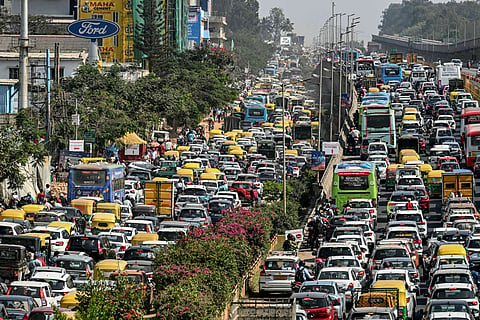

Karnataka Chief Minister D K Shivakumar’s ambitious ₹1.5-lakh-crore blueprint for transforming Bengaluru’s infrastructure is born of a genuine problem. India’s technology capital is straining under the weight of rapid urbanisation, chronic congestion and ageing civic infrastructure. Yet the scale of the proposed interventions raises a fundamental question: does Bengaluru need monumental engineering projects, or better urban governance?
The multi-phase plan envisages a 2.2-km tunnel connecting the congested Hebbal junction with the Gandhi Krishi Vignana Kendra campus, followed by another 40 km of tunnel roads, a 44-km double-decker flyover and the 123-km Bengaluru Business Corridor. Besides the staggering cost, these projects involve years of disruptive construction in one of the country’s most traffic-choked cities. The economic and social costs of prolonged disruption deserve as much scrutiny as the projects themselves.
One proposal stands out for its long-term promise. Shivakumar’s call to create “more Bengalurus beyond Bengaluru” by strengthening tier-2 and tier-3 cities recognises that the state’s growth cannot remain concentrated in one metro. Developing satellite townships and creating comparable economic ecosystems elsewhere could ease migration pressures on the capital more effectively than endlessly expanding its road network.
Urban planners, mobility experts and civic groups have consistently argued that building more roads rarely solves congestion; it often induces more traffic. Bengaluru already adds around 30,000 new vehicles every month. Expanding road capacity without fundamentally changing travel behaviour risks deepening the city’s dependence on private vehicles rather than reducing it.
The more urgent agenda is less glamorous but far more consequential: well-maintained roads, continuous and safe footpaths, protected cycling infrastructure, reliable last-mile connectivity to Metro stations, stronger public transport, better stormwater drainage, scientific waste management and stricter traffic enforcement. These are neither headline-grabbing nor politically spectacular. But they are quicker to execute, less expensive and more likely to improve the quality of urban life.
With less than two years before the next Assembly election, Bengaluru would benefit more from visible improvements in everyday civic services than from promises of engineering marvels that may take years to materialise. The city needs infrastructure that works before it seeks infrastructure that dazzles.
