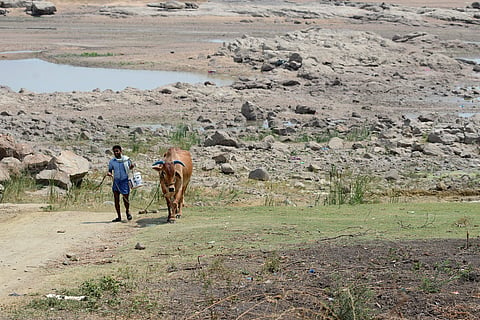

The crisis Karnataka’s farmers are facing because of a severe monsoon deficit is likely to have national ramifications. By the first week of July, merely a third of the targeted kharif crop sowing had been achieved. The agricultural season from June to October normally yields a robust mix of coarse cereals and food grains like paddy, maize, ragi (finger millet), jowar (sorghum) and bajra; pulses like tur (pigeon pea) and various grams; oilseeds like groundnut, sunflower, soybean and niger seed; and cash crops like cotton, sugarcane, tobacco and red chillies.
All of this is directly dependent on the monsoon. Karnataka has the second largest pool of arid lands after Rajasthan and 84.79 lakh hectares of rain-fed farmlands, making agricultural production highly dependent on the monsoon. The severe rain shortfall caused this year by El Niño conditions has meant that the regions of Malnad (the area in the Western Ghats that has catchments for some of the state’s major rivers), the coast, north interior Karnataka and south interior Karnataka face rainfall deficits of 34 percent, 30 percent, 24 percent and 18 percent, respectively. The impact is unlikely to be limited to Karnataka. The state is the largest producer of coarse cereals in India, along with the largest acreage among states allotted to tur dal cultivation. A major decline in Karnataka’s output is bound to affect food prices across the nation.
The human crisis is also getting worse by the day. With 1.37 crore people or one in every five denizens of Karnataka dependent on agriculture, Chief Minister D K Shivakumar has appealed to Prime Minister Narendra Modi to send a central team to assess the situation first hand and help mitigate the problem.
Whatever the help from the Centre, a lesson needs to be learnt in Karnataka about successive governments’ neglect towards making the state’s agriculture significantly less dependent on monsoon rainfall. Instead of focusing primarily on developing Bengaluru with mega plans costing ₹1.5 lakh crore, the government needs to divert resources towards expanding irrigation, improving water conservation, shifting to drought-resistant crops, expanding canal networks, increasing groundwater recharge and adopting precision micro-irrigation systems. This is not just to protect the state’s agrarian community—but to ensure farming is not held hostage to the vagaries of nature forever.
