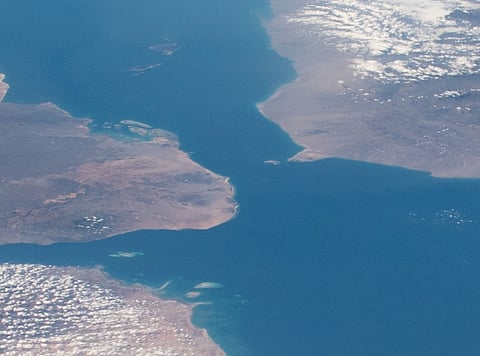

The Houthis’ threat to disrupt shipping through the Bab al-Mandeb Strait has delivered a double whammy to global energy markets, exposing a dangerous new fault line in energy security. As Saudi Arabia increasingly relies on the Red Sea route to bypass the largely-blockaded Strait of Hormuz, the prospect of simultaneous disruption at both passageways threatens to choke the Gulf’s principal export alternatives. The result would not only be tighter oil supplies, but a transportation crisis capable of driving crude prices back above $100 a barrel, inflating freight and insurance costs, and disrupting global trade. For India, the world’s third-largest oil importer, the risks extend beyond a higher import bill to renewed inflationary pressures and supply-chain disruptions, yet again highlighting that maritime security has become as critical to economic stability as energy production itself.
Saudi Arabia currently diverts an estimated 4-5 million barrels a day through its East-West pipeline to the Red Sea port of Yanbu, reducing dependence on the Persian Gulf route. If both chokepoints come under sustained pressure, the global oil market would lose its principal contingency route.
The disruption would extend beyond crude. Europe relies heavily on diesel and jet fuel shipments from Saudi Arabia and Asia that pass through Red Sea and Suez Canal. Any prolonged interruption would tighten already-fragile markets, push refining margins higher and add another wave of inflationary pressure on advanced economies. Longer routes around the Cape of Good Hope would further raise transport costs and delay deliveries.
The implications are particularly acute for India. Higher crude prices, combined with rising freight and insurance costs, would widen the import bill, pressure the current account and complicate inflation management. While diversified sourcing and strategic petroleum reserves provide some cushion, they cannot fully offset the impact of simultaneous disruption at two of the country’s most important maritime supply routes.
Energy security is not just about producing oil—it is also about keeping it moving. Bab al-Mandeb is Hormuz’s safety valve. If it closes, the global economy loses its only credible fallback. The trajectory of the West Asia crisis will be determined as much at sea as on land. For major energy importing economies such as India, securing these maritime lifelines is no longer simply a strategic objective. It is an economic imperative.
