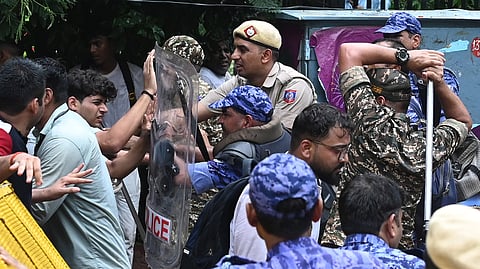

The Supreme Court struck the right note on Tuesday by ordering the release of all detained underage protesters without criminal history and proposing an independent enquiry into the violence wreaked at student agitations across the country. As MPs in Parliament demanded accountability for and action against the police excesses committed on student protesters, the top court noted such cases in the BJP-ruled states of Delhi, Maharashtra, Bihar, Assam, Uttar Pradesh, Madhya Pradesh and West Bengal, and the Congress-ruled Kerala. Charges of the forces using pellet guns, rubber bullets, electric batons and nail-studded lathis were put on record.
It’s a moment to acknowledge that the application of disproportionate force against a spontaneous democratic expression cannot be condoned. Undue coercive action can push the people back on the streets—something no government would want. The Centre and states should learn from the fact that every time the heavy hand of police came down, the protesters came back in larger numbers, with a longer list of complaints against government ineptitude.
Consider also the dark irony that while students were braving police action to demand a better education system, fresh allegations of leaked questions and mass cheating emerged from four states in July alone. At stake were the recruitment of 154 food and drug inspectors in Maharashtra, an ayurvedic medicine exam in Gujarat, the hiring of 454 pharmacy officers in Punjab and two engineering semester exams in Uttarakhand. It’s as if a supremely inefficient and corrupt system is continuing to mock at the aspiration of young Indians while the State machinery tries to crush their legitimate remonstrations. A broken education system is especially debilitating for a services-exporting nation that is still trying to pull the world’s largest cohort of people out of extreme poverty.
Administrations are bound to maintain balance while dealing with dissent, especially in a country where, by the government’s own admission, one in every six employable youngster aged below 30 is jobless. Bihar’s action against a policeman accused of firing an assault rifle at protesters needs to be emulated in other jurisdictions.
The Supreme Court has started with an appropriate intervention. We hope it will walk the talk when it is time to decide on the substantial questions of the protesters’ right to equality and personal liberty, freedom of expression and peaceful assembly, and safeguards against arbitrary detention.
