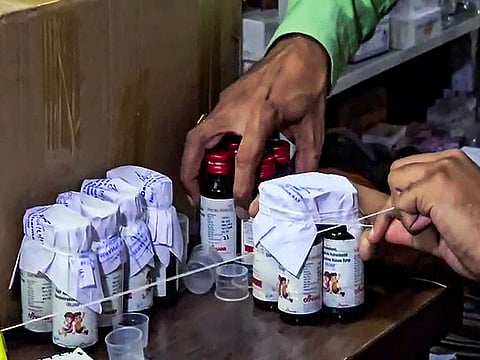

The government’s recent notification barring over-the-counter sale of cough syrups is a prescription too mild, issued too late. It has come eight months after the death of 24 children in Madhya Pradesh within weeks of consuming a cough syrup. This was not even the first such case to be reported—Indian cough syrups laced with a toxic industrial solvent have led to deaths in other states and abroad, too.
On June 15, the Union ministry of health and family welfare amended the Drugs Rules, 1945, removing the word ‘syrup’ from Schedule K of the rules to prohibit their OTC sales, mandating prescriptions from registered medical practitioners to buy and allowing only licensed pharmacies to sell them. This means that the syrups that were earlier easily available from non-pharma stores, too, will now be out of bounds in villages that lack medical stores.
These restrictions are inadequate when coupled with weak enforcement of drug rules and manufacturing quality control. Wide gaps in the Central Drugs Standard Control Organisation’s staffing, structure and capability have been noted for long. There are loopholes in the distribution system, too. Apart from unethical practices like medical practitioners selling company samples shared with them, medicines are now sold on the internet, too—not always by registered, compliant firms. The task of monitoring and enforcing such a massive system is Herculean. The urgent need is to ensure a better-staffed and better-equipped CDSCO coordinating much more efficiently with state drug control organisations. Manufacturing processes need to be regularly audited, with their reports reviewed by central auditors. Politics needs to be kept out of this effort.
India’s pharma industry is valued at about $60 billion, the third largest in the world by volume. Its aspiration to grow to $130 billion by 2030 is already being thwarted by supply chain dependence on other countries, which has been exacerbated by geopolitical upheavals and global price fluctuations. In such a challenging situation, if we really want to be the ‘pharmacy of the world’, we cannot afford to let quality control remain so inadequate. The WHO has flagged Indian cough syrups as the reason for the deaths of more than 120 children in Africa and Central Asia. Changing the global image into something positive will require overhauling the industry to put in place a stricter, more capable regulatory regime that enforces without fear or favour.
