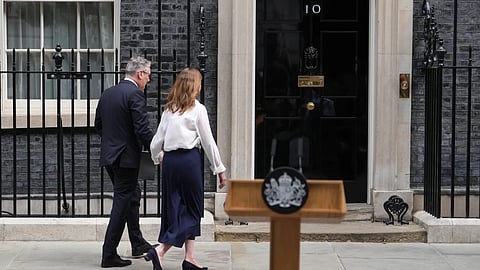

Keir Starmer’s resignation is more than the downfall of a Prime Minister. It is the latest symptom of a political system in the midst of a historic realignment. Less than two years after delivering Labour’s biggest victory since Tony Blair’s 1997 landslide, Starmer exited on Monday as Britain’s sixth prime minister in a decade—an extraordinary churn for a country once synonymous with political stability. His fall is even more striking because it was not triggered by a recession, a military defeat, or a major scandal. Rather, Starmer squandered a historic mandate through a combination of political misjudgements, policy reversals and the inability to define a compelling national project. Measures such as cuts to winter fuel support and welfare reforms alienated Labour’s traditional base, while subsequent U-turns projected weakness rather than pragmatism. Voters who had backed Labour in 2024 for stability increasingly saw a government drifting between competing priorities.
The deeper problem, however, extends well beyond 10 Downing Street. The resignation comes at a time Britain’s centuries-old two-party system is unravelling. For the past century, Labour and the Conservatives commanded the overwhelming majority of votes. Today, both parties are losing support to challengers on the left and the right, producing an unprecedented five-way political landscape in which Labour, Conservatives, Reform UK, Liberal Democrats and Greens are competing for substantial shares of the electorate.
The most significant beneficiary of this fragmentation has been Reform. Nigel Farage’s party is no longer a mere protest vehicle. It has become a repository for voters who feel economically insecure, culturally alienated and politically ignored. Reform’s rise reflects a broader transformation in British society marked by declining trust in institutions, growing frustration with stagnant living standards and renewed anxiety over immigration. What makes Reform’s advance particularly consequential is that it cuts across traditional class loyalties to attract working-class voters who once formed Labour’s backbone and middle-class Conservatives disillusioned with their own party.
The result is an unprecedented level of volatility. The parade of prime ministers marks the political instability. Starmer’s departure confirms that even commanding parliamentary majorities are no longer guarantees of authority. The challenge facing his successor, in all likelihood Andy Burnham, will not just be rebuilding Labour. It will be governing a country whose political loyalties, social identities and expectations are changing faster than its institutions can adapt.
