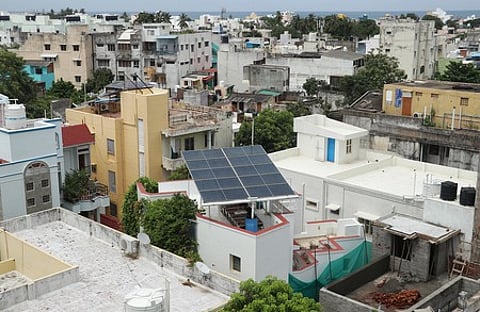

A nationwide study has found that the country’s rooftop solar power generation capacity is growing in a markedly lopsided manner. The Bengaluru-based Climate Compatible Futures has found that while the top three states of Gujarat, Maharashtra and Kerala have as much as 6,882 MW, 5,442 MW and 1,850 MW in installed capacities, respectively, the eastern states of Odisha, West Bengal, Jharkhand and Assam are lagging far behind, with as little as 156 MW, 67 MW, 95 MW and 344 MW.
Of India’s total solar capacity of 157.04 GW, large farms account for 118.79 GW, while the grid-connected rooftop panels on buildings account for 27.88 GW, and off-grid wind-solar hybrid setups stand for 10.37 GW. The rooftop segment is seen as a crucial component of the Union government’s target of installing a total solar capacity of 280 GW by 2030 and 800 GW by 2035. Its uneven growth could hobble India in its race towards the targets if the causes remain unaddressed.
The rooftop solar push is supported by national programmes like the PM Surya Ghar Muft Bijli Yojana, which provides subsidies for household installations. But subsidies alone cannot sustain the growth. They need to be supplemented by spreading awareness about the hardware and installation processes among the citizens along with the benefits of solar power over conventional sources. More Indians need to realise that a rooftop solar installation is an asset through net electricity metering, a billing mechanism that credits money to households for contributing surplus electricity to the grid.
The CCF study found that in many eastern states, the vendor base is thin, households are poorly informed about the modalities and benefits, and the financially-stressed distribution utilities are more cautious in responding to requests. These factors come in the way of popularising rooftop installations.
Meeting India’s climate targets for 2035 demand economy-wide commitments such as reducing emissions by 47 percent, bringing up installed capacity from non-fossil sources to 60 percent, and scaling up the solar capacity to about 29 percent of the total to become the largest part of the clean energy mix. Helping us overcome the challenges can be a more uniform push for rooftop solar power in all states. That can happen if we see it as a key to a more sustainable future.
