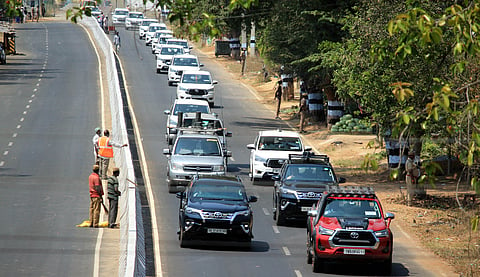

The VVIP convoy culture is like a slow-spreading blot on India’s democratic fabric. As the number of those officially recognised as ‘very very important persons’ has grown, it has left ever-lengthening traffic snarl-ups in its wake. The common citizen often watches dignitaries passing by with elaborate security arrangements—complete with pilot vehicles, multiple escort cars, an ambulance, a signal-jamming vehicle and other support vehicles. A Congress MLA in Punjab even claimed in 2022 that his own party’s Chief Minister had a convoy of 42 vehicles, longer than the previous incumbent’s 33.
Although the Union home ministry’s guidelines clearly stipulate that traffic should not be stopped for most VIPs—with exceptions limited only to a handful of top-level dignitaries—these instructions are routinely ignored. Given the widespread public frustration this causes, Tamil Nadu CM Joseph Vijay’s recent ‘people-first’ approach to traffic management has earned appreciation. Vijay has mandated that public vehicles, ambulances and school buses be allowed to move alongside his convoy. Instead of halting all other traffic, his motorcade uses just one lane while a parallel or opposite lane is kept fully open to public. Temporary barricades used to separate the CM’s convoy from other lanes are promptly removed once the motorcade passes. It’s not a surprise that this, along with Vijay’s occasional practice of skipping the standard security protocol to drive his own car, has struck a chord with the general public.
However, Vijay is not the first leader to adopt such a traffic-friendly measure. In 2021, former CM M K Stalin had pruned the length of his motorcade by almost half after it had caused a major traffic jam in Chennai. Revanth Reddy in Telangana and Uddhav Thackeray in Maharashtra, too, had opted for smaller convoys. More recently, the Prime Minister’s convoy was sharply reduced to convey a message of austerity in the face of the global fuel crisis. Other ministers also trimmed their fleets.
This should not be a matter of choice, but a standard arrangement reviewed by the security agencies and implemented by the police. Smaller convoys, limited movement along a temporarily barricaded lane and better transit planning to avoid peak hours should be instituted for all. Our leaders must remember that they are elected to serve the people—not to get in their way.
