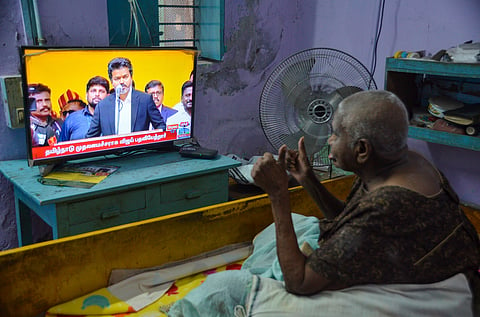

As Tamil Nadu welcomes a new government under actor-turned-politician C Joseph Vijay, the state stands on the threshold of a new political era. The duopoly of the Dravidian majors, which ruled the state continuously for six decades, has ended unceremoniously. Notably, after several decades, a coalition government is taking charge in the state.
Vijay’s journey to power was marked by twists and turns reminiscent of a Kollywood blockbuster. His fledgling TVK fell short of the halfway mark in the Assembly, and despite a clear public mandate against the established Dravidian parties, he initially struggled to cobble together support. He eventually secured backing—largely from the DMK-led alliance—though with only a slender majority. Whether TVK can retain that support and run the administration effectively remains to be seen. However, with evidence of a surge in grassroots support for Vijay across the state after the polls, the two major opposition parties are unlikely to pull the plug anytime soon. Instead, they may prefer to wait and see whether the government falters under mounting pressure.
Right after taking charge, Vijay got down to business. He set up a women’s protection force to curb crimes against women and anti-drug squads in every district. He also sought to ease the burden on electricity consumers by making the first 200 units free. His promise of a clean and transparent government may have sounded like a typical mass-hero dialogue from a Tamil film, but it has nevertheless raised expectations across the state. Vijay said his government would focus on education, road safety and drinking water facilities—priorities that have resonated with many people. Underlining his commitment to a secular, anti-BJP stance, he also assured minorities that he would always stand by them.
Vijay’s statement that the DMK had left behind a debt burden of around ₹10 lakh crore, coupled with his promise to release a white paper on the state’s finances, may help him delay the implementation of his new social welfare measures. According to TNIE’s estimates, the annual cost of the planned welfare expansion could reach nearly ₹1 lakh crore—almost half of Tamil Nadu’s own tax revenues last year. Unless the government beefs up its tax kitty and identifies new income sources, it may struggle to invest adequately in civic and road infrastructure. That, too, should remain a priority.
