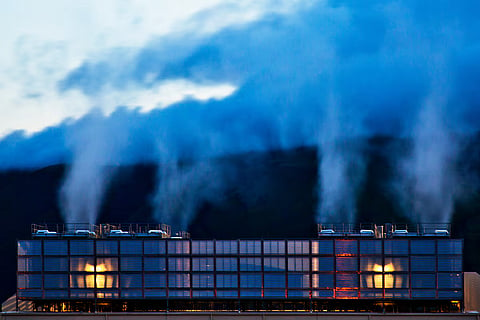

India's hunger for data is growing fast, thanks to the spread of 5G networks and artificial intelligence. But though the country today generates 20 percent of global data, it stores less than 3 percent within its boundaries. This poses a substantial risk to sovereignty, especially given the rapid shifts in geopolitics and cybersecurity. In such a scenario, Andhra Pradesh’s aim of becoming the country’s data centre hub offers a promising solution. On top of a 1-gigawatt AI data centre being built near Visakhapatnam by Google, AdaniConneX and Nxtra, the state is considering a 1.5-GW project by the Reliance group. Both projects propose to start operations by 2028.
As with all data centres, the first challenge is planning for their substantial requirements of water and power. Both these mega projects propose to set up their own solar plants, with the state government granting a special deemed distributor licence to the first project to independently manage its power needs. If such a clearance is granted to the new project too, both will bypass the public electricity grid.
The other challenge to India’s data centre push is that it has only 4 percent of the world’s freshwater supplies. Andhra Pradesh’s 2026-27 budget puts the state’s water requirement at approximately 1,490 thousand million cubic feet against an availability of 1,565 TMCs through its rivers. The surplus, which is not assured, may not be enough for the state’s data centre ambition. Storage is a challenge, too. Hence, the Greater Visakhapatnam Municipal Corporation is planning to build a desalination plant to process 100 million litres a day. A dedicated allocation is being planned from the Polavaram project, too.
Expanding storage capacity is an imperative for modern economies. But while India ramps up, it must learn from the West, where resistance is building up because of the significant public resources diverted to run data centres. India cannot afford a misstep on this count—it needs to balance the needs of agriculture, other industries and the people while expanding data centres. At the current pace, the country will need five years to meet the domestic demand. Meanwhile, it must work on developing advanced cooling technologies, effectively using the heat data centres generate and enforcing enhanced pollution control standards. In this, too, Andhra Pradesh can show the way.
