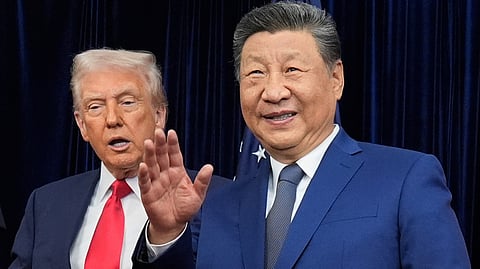

This week, the Strait of Hormuz emerged as the common thread linking two very different diplomatic theatres—the Trump-Xi summit in Beijing and the BRICS foreign ministers’ meeting in New Delhi. What emerged from both gatherings was recognition that the West Asia conflict is no longer just a regional war; it is now a test of the global energy order, strategic alignments and the limits of great-power influence.
After the Beijing summit, US President Donald Trump claimed that Chinese President Xi Jinping had agreed that Tehran must reopen Hormuz. The formulation was revealing: Washington no longer sees the strait merely as a maritime chokepoint, but as a central pressure point in dealing with its closest challenger. Yet, Trump’s remarks also betrayed the limits of American leverage. Even as he warned that his “patience” with Iran was running out, he acknowledged he was “not asking for any favours” from Xi—a tacit admission that Beijing’s influence over Tehran is consequential but not controllable.
China, for its part, walked a calibrated line. Beijing reiterated opposition to the war, criticised the militarisation of the strait and emphasised dialogue over coercion. However, it stopped short of endorsing Washington’s maximalist framing on Iran. Instead, China focused on energy security, supply chains and negotiated de-escalation.
A similar balancing act was visible at the BRICS meeting in New Delhi. Iran dominated the discussions, exposing the contradictions within an expanded BRICS that now includes both Iran and the UAE, rival actors standing on opposite sides of an active conflict. Iranian Foreign Minister Abbas Araghchi pressed the grouping to explicitly condemn the US and Israel, while the UAE countered with criticism of Tehran’s actions. The resulting divisions prevented consensus on a joint statement, underlining that BRICS’ ambition to reshape global governance is constrained by hard regional rivalries.
For India, hosting the meeting was diplomatically delicate. New Delhi has a direct stake in keeping Hormuz open, while it also seeks to preserve strategic ties with Washington, Tehran and Abu Dhabi. The meetings in Beijing and New Delhi brought to focus a new geopolitical reality: the future of the Strait of Hormuz is no longer just about Iran; it is now an arena where US power, Chinese influence, BRICS cohesion and global energy security are colliding.
