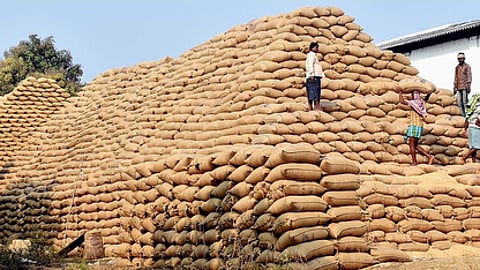

Telangana is grappling with a problem of plenty that is accentuating an economic and infrastructure conundrum. The state’s record production of paddy during the ongoing rabi season has, paradoxically, made things more difficult for it. The state was nowhere near the country’s top paddy producers a decade ago. But increased irrigation and financial support attracted farmers to increase acreage and helped the state become one of the top producers. Now the boon, so to speak, has become a bane.
Paddy is procured primarily by the state government, with the Centre usually taking its own time to pick up a part of the produce through the Food Corporation of India. The contention between the two is mainly about quantities. The Union government caps procurement at a much lower level than the actual production, leaving the state to do the heavy-lifting.
This season, Telangana produced an estimated 140 lakh metric tonnes of paddy. After purchasing directly, the state will store, process and distribute the grain through the public distribution system; a part of the surplus will be delivered to the FCI. This year, the state’s target for procurement is 70 LMT, while the Centre’s is 52 LMT. Private rice millers will profi t from the larger gap between production and government procurement.
Meanwhile, given the inadequacy of storage at the state’s 8,575 procurement centres, farmers are forced to leave heaps of the produce out in the open. This year, a substantial share of it has already been damaged by heavy rains. It requires no expert to point out that the state needs many more storage facilities.
Paddy production surge has left Telangana vulnerable in more ways than one. The Centre has advised the state to pare about 25 lakh acres from its paddy cultivation area of more than 130 lakh acres, and ensure crop diversifi cation—with good reason. To store what’s procured, Telangana needs to borrow from banks to pay the farmers and buy storage; by the time the central reimbursements arrive, interest adds up on the loans. Even exports are not proving to be an effi cient outlet. Given this, the only sustainable way out is to create awareness among farmers and incentivise them to ensure crop diversification.
