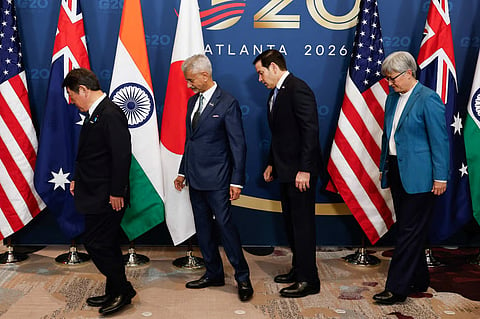

As the Indo-Pacific remained firmly in focus at a flurry of summits in Manila on the first two days of the week, China featured as the elephant in all the summit rooms. The Quad leaders, who met after a gap of two years, hardly minced words when their joint communiqué expressed “grave concerns about economic coercion, including through arbitrary export restrictions”, pointing at China’s stranglehold on critical minerals that it has weaponised in response to the US’s imposition of tariffs and technology export curbs. The group comprising the US, Japan, Australia and India also committed to closer cooperation on maritime surveillance, artificial intelligence, energy and cybersecurity. It’s the result of quiet work by the four foreign ministers, who met a number of times to streamline the group’s working themes even as the leaders skipped their summit.
The US sees the Quad largely through the prism of strategic competition with China. However, the Jakarta-headquartered ASEAN does not want to be forced to choose strategically between Washington and Beijing. While it signed a disaster response and early warning pact with India, what remained unsaid in Manila was the tepid growth in trade between the bloc of 11 Southeast Asian nations and India. Here, too, China’s influence in the region acts as a speed-breaker, fomenting worries about rules of origin and the possibility of Chinese-made products gaining preferential access after minimal processing in a third territory.
As diplomatic action shifts for the rest of the week to Shenzhen for the APEC Summit and the first China-Russia-US trilateral, India must focus on negotiating the shifting geopolitical currents that may be made even more unpredictable with the emergence of a G3 among the three military superpowers, even if it’s temporary and tactical. It must break the deadlock in concluding the free trade pact with ASEAN and offer the bloc’s members better access, investment, technology and dependable maritime partnership. Trade routes, supply chains and technology are on the same security map that India pores over with Quad partners. While the Quad’s prominence waxes and wanes with the mood of its most formidable constituent, the US, India should continue strengthening cooperation with the other two members. Whatever the shape of the world order to come, bilateral relationships will never go out of fashion.
