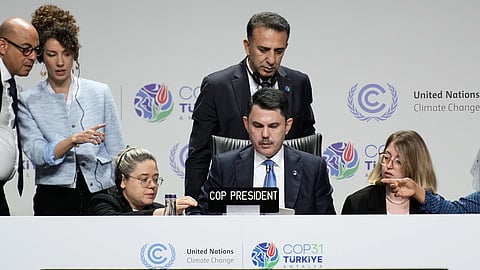

Fourteen days of negotiations in Antalya ended without a pact to save the planet from even more climate extremes. At COP31, the failure of close to 200 nations to reach a consensus exposed deep fissures in global climate diplomacy. The latest draft of a proposed deal—released Sunday, two days beyond the summit’s official wrap-up—brought to the fore more friction over who should bear the cost of climate action.
The negotiations broke down over fossil fuel use, climate finance and the responsibilities of developed and developing countries. The draft, prepared by the joint presidencies of Australia and Türkiye, failed to bridge these differences, with the European Union and other developed nations objecting to what they called the wide gulf between commitment and action. The failure to secure a deal is a telling blow on multilateralism, which is at the heart of climate action.
Not surprisingly, the mere reference to fossil fuels has emerged as the most contentious issue. A coalition of around 130 countries pressed for stronger focus on transition, only to meet stiff resistance from Saudi Arabia and other oil-producing nations. A carbon capture and storage proposition added to the chaos with rich nations arguing such technologies would end up prolonging fossil fuel dependence. A commitment on climate finance for developing countries to cope with the consequences of the crisis they did not create was not asking for too much. But it ended up being another stumbling block. African ministers’ retort—“We are not here to beg”—on the omission of an annual adaptation finance framework spoke volumes. For small nations grappling with devastating floods, droughts, cyclones and rising sea levels, climate ambition without financial commitments from rich nations only sounds like diplomatic rhetoric.
The collapse of the talks also reflects a deepening North-South divide. India and other developing countries have consistently argued that climate action must respect equity, historical responsibility and the principle of common but differentiated responsibilities. Their development priorities and energy security cannot be hostage to uniform emission-reduction prescriptions. Equally, the industrialised countries cannot evade their financial obligations while demanding faster decarbonisation. The hypocrisy of the rich cannot be mistaken for commitment. The way forward requires political pragmatism rather than another round of posturing. The climate clock will not wait for nations to find common ground.
