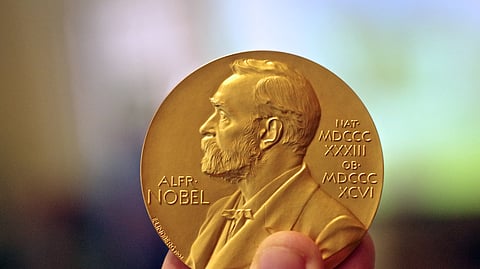

It’s fascinating to note the pathbreaking achievements of scientists when Nobel Prizes are announced every year. Karl Deisseroth, Peter Hegemann and Georg Nagel won the coveted honour in physiology this year for discovering the use of light in turning on specific brain cells, which can help treat diseases. In physics, Francis Louis Halzen was awarded for his work on neutrinos, the so-called ghost particles that help us see the universe in a different light. In chemistry, Henri Boris Kagan and Kensō Soai won for their work on mirror molecules that may go a long way in manufacturing medicines.
The world rightly celebrates such achievements. We in India do, too—but with a nagging question at the back of our minds. Why, after C V Raman’s Nobel for physics in 1930, have we not been able to produce a single winner in the basic sciences? It’s surely not for the lack of brilliant scientists. Over a century, several Indians came within a whisker of Nobel glory—Homi Bhabha, Satyen Bose, Meghnad Saha, G N Ramachandran and C V Seshadri among them.
To what extent do we celebrate their work? How many know that Indian scientists co-pioneered the quest for detecting neutrinos at the Kolar gold fields in 1965? India even sought to set up a neutrino observatory in 2001, which finally got the green light in 2015. But the project has not moved an inch over red tape linked to unanswered ecological questions. It encapsulates a major hurdle such research faces in India.
Another factor is that the country spends less than 1 percent of GDP on research and development, about a third of what China does. Most of those meagre funds go to premier institutes, while state universities—where four out of every five Indians are educated—are starved. Lack of autonomy in hiring comes in the way of keeping bright minds in the country. The Anusandhan National Research Foundation’s target corpus of `50,000 crore looks impressive, till we realise that the Centre proposes to fund only 28 percent of it and the private share is growing at a snail’s pace.
Apart from funding and unfettering research, we also need to inculcate scientific temper in schools, which can be spurred by celebrating our scientists. More science museums can also seed a cultural shift. Otherwise, we will be left with chest-thumping about a glorious past.
