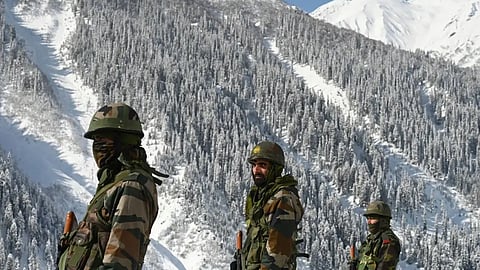

Back in August, when India formally marked with names 27 geographical locations and features on the Arunachal Pradesh map, it appeared to be only a nomenclatural tug-of-war with China. It had been up to mischief, assigning its own names to places in Arunachal. President Xi Jinping was due in India the following month, after a seven-year gap, for the BRICS Summit—hence a gentle but firm riposte. But the larger context was not immediately apparent then: it turns out that a face-off with the People's Liberation Army (PLA) has been ongoing since July at multiple locations on the Arunachal border. Reports suggest incursions, with the PLA setting up tents about 6-7 km within the Indian side of the Line of Actual Control (LAC) at Asaphila near Taksing in Upper Subansiri district.
Indo-Tibetan Border Police (ITBP) Director General Shatrujeet Kapur has put things on record as a matter of internal dialogue. Shortly after the remarks, Congress president Mallikarjun Kharge asked whether another serious confrontation was brewing in Arunachal on the lines of the 2017 standoff at Doklam and the 2020 Galwan clash. The Ministry of External Affairs, on its part, issued a nuanced statement saying the border is disturbed from time to time when Chinese forces deviate from established patrolling patterns. “Both sides continue to use existing diplomatic and military mechanisms to resolve outstanding issues and avoid misunderstanding and miscalculation along the LAC,” it said, in equable tones. Kapur’s open ventilation was thus likely part of an orchestrated exercise, cleared at the highest level, to add breadth to the message going out to Beijing officially.
The latest face-off comes against the backdrop of intensifying strategic competition among major powers. While the border has its own dynamics, it also underscores India’s challenges in navigating an evolving regional and international order. Despite a visibly slowing Chinese economy, the surge in India’s imports from China has widened the bilateral trade deficit to $112.16 billion. Despite that asymmetry, China recognises India’s growing stature, in substantially the same vein as the US. For an honest expression of the latter, take Deputy Secretary of State Christopher Landau’s words: “We are not going to make the same mistakes with India that we made with China 20 years ago…” India’s needs will therefore be met through a full exercise of sovereignty, whether in pursuit of peace on the border or an equitable trade deal.
