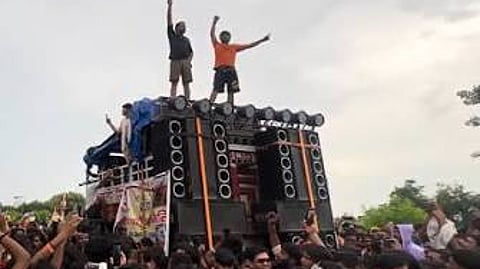

What could be more shockingly symptomatic of India’s noise pollution epidemic than a violent mob silencing a musician who protested loudness? The death of Chongtham Vikram Singh, a Manipuri musician in Delhi, at the hands of a mob that included an adolescent boy is the latest extreme manifestation of a growing disregard for the health and peace of others among Indians who equate celebration with loud noise. The disturbing irony in Singh’s case was compounded by the silence of his neighbours as he was chased and beaten near his apartment.
The 47-year-old musician’s death was not an isolated incident. Loud music has become de rigueur at private functions and communal festivals, while complaints against it are increasingly provoking violent reactions. Last week, 45-year-old Satish Sharma succumbed to injuries sustained after he was pushed down a staircase following his complaint about loud music from a neighbour’s house in Noida. Pune-based civic activist Vidyanand Bapat was assaulted on camera after complaining about loud DJ music during Ganesh Chaturthi celebrations. Several instances of mob violence were also reported during recent Kanwariya yatras against those protesting ear-splitting music played on stacked sound systems.
Yet India has long recognised noise pollution as a public health hazard. Ambient noise was officially recognised as a pollutant in 2006 and, in 2011, the Central Pollution Control Board announced a National Ambient Noise Monitoring Network. However, a study published in Nature earlier this year found that Indian cities are growing harmfully louder, including around hospitals, schools and residential areas. The World Health Organization has warned that prolonged exposure to excessive noise can contribute to cardiovascular disease, sleep disruption, cognitive fatigue, and poorer work and school performance. The warnings, evidently, have fallen on deaf ears.
The official apathy is appalling. This March, the government informed the Lok Sabha that it had not conducted any study to measure the health impact of car honking and loudspeaker noise, despite its own department recommending such research. Loud noise particularly affects expectant mothers, young children and the elderly. The authorities must stop merely paying lip service to a growing public health hazard and strictly enforce rules governing both the decibel levels and permitted hours of noise. Celebrations cannot become a licence to rob others of their health, sleep and peace. All Indians deserve a peaceful festive season.
