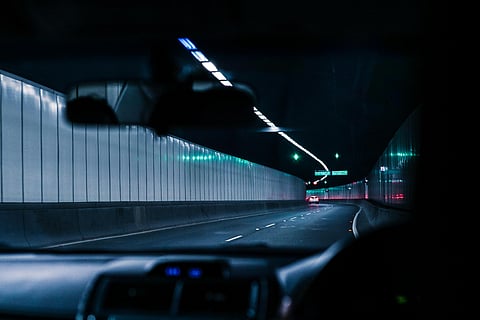

Karnataka Deputy Chief Minister D K Shivakumar, also the minister in charge of Bengaluru’s development, has floated the idea of having a 60-km north-south and east-west network of underground roads to decongest the city. He has proposed the first one linking a location near Esteem Mall on Bellary Road in north Bengaluru with the Silk Board Junction in southeast Bengaluru—a distance of 18.5 km. There are some major challenges facing this proposed mega project. It is estimated to cost Rs 30,000 crore, or Rs 500 crore per km, according to the deputy CM’s letter to Union Finance Minister Nirmala Sitharaman seeking central funds in December 2023. At the same time, the state government is staring at a Rs 56,000-crore annual spend on the five guarantees promised during last year’s poll campaign.
Experts have warned that a thorough scientific assessment of the soil structure and profile is a must, considering that sinkholes appeared during the city metro’s underground works. Bengaluru’s average soil profile across its 750-square-km area includes layers of weathered or hard rock starting at about 8 metres below the surface. Above it is a layer of medium to dense silty sand with clay, gravel or filled-up soil. Considering that the surface layers are becoming increasingly fragile in urban areas due to frequent infrastructure work, utmost diligence should be the priority if the tunnel project is undertaken.
The city has a high population and construction density, which makes it extremely challenging to burrow under without adversely impacting life and property overground. The project would also need to avert underground structures such as water and sewage pipelines, the metro’s underground segments, and the deep foundations of some high-rise structures. Given the hard rock base in a densely-developed city, a project such as this would be extremely challenging.
Crucially, adding roads—overground or underground—would mean encouraging greater use of private vehicles. Also, the city already has a poor record of maintaining subways that are regularly flooded during heavy rains and have even claimed a life. The safety of the underground tunnels would be top of the mind for Bengalureans. The better and cheaper alternative would be to qualitatively improve and quantitatively expand the existing public transport infrastructure with greater investments in bus and metro connections. Safer, quicker and more comfortable intra-city travel is a dream in a congested city like Bengaluru.