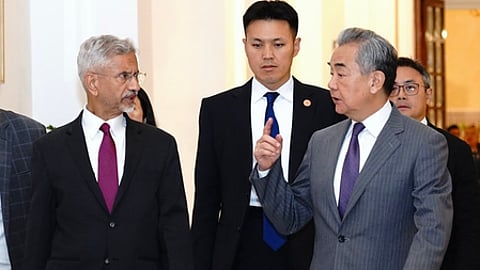

US President Donald Trump’s punishing tariffs on Indian goods have had a crippling effect on many manufacturing exporters. Yet, in many ways, it is a blessing in disguise. It has forced diversification, reduced India’s dependence on the US, and prompted it to seek new friends. For instance, the new bonhomie with China is seeing instant payback. China had tightened the supply of rare earth minerals following the tariff war with the US. These are essential inputs for products such as smartphones and EVs. Since China has a monopoly on rare earths, India too has suffered collateral damage to its supply lines. Now, thawing relations with China have led at least four Indian companies to receive licences from China to import rare earth magnets (REMs).
Improving relations with China is also paying off, with exports to China surging 22 percent to $8.41 billion in the April-September period this year, compared to $6.90 billion for the comparable period last year. Though the trade imbalance is still hugely in favour of China, with the latter exporting $113 billion, what is significant is that India is now seeking out alternative markets to the US. Here we can take a leaf out of China’s playbook. Hit by high tariffs, China’s exports to the US in September this year declined 27 percent to $34.3 billion, compared with $47 billion in the same month last year. Despite this steep fall, Chinese exports are up 6.1 percent this year, with September showing an 8.3 percent increase over last year. China is finding new export markets.
When the tariffs were imposed in August, India was caught on the wrong foot. The US accounts for 18 percent of our exports. Since then, the ‘Atmanirbhar Bharat’ slogan has been reactivated, and local companies are focusing on boosting domestic sales. The government, too, has eased credit lines to micro and small units and initiated production-linked incentive (PLI) schemes that offer incentives for increasing sales across 14 key sectors. However, finding alternative markets to the US will be key. In this respect, there should be a speedy closure to the ongoing Free Trade Agreement (FTA) talks with the European Union. Even if the US at some stage rolls back its tariffs, India must not veer off its long-term diversification course