
When filmmaker V Shantaram directed and produced Geet Gaya Patharon Ne in 1964, he would not have imagined that his film will translate into reality after
almost half a century. Infused with life and beauty, more than hundreds of rock marvels come alive in the dimly-lit ambience of the School of Sculpture, KIIT University.
A brainchild of Dr Achyuta Samanta, the founder of Kalinga Institute of
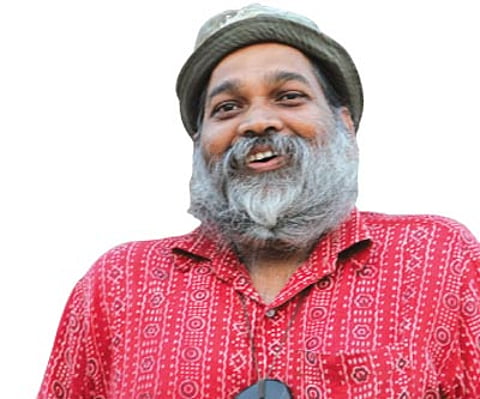
Industrial Technology, the school is now in a nascent stage. It started taking shape almost a year ago under the able hands of Adwaita Gadanayak, a sculptor par excellence. A first-of-its-kind institute in the country, the work began with a lot of brainstorming about the course curriculum, as it wasn’t just about imparting theoretical knowledge to students.
First batch in June
The school, spread across a sprawling 10-acre of land, will admit its first batch in another six months and offer a two-year master’s programme in Fine Art in Sculpture. The four-semester course will comprise eight projects that are based on different concepts.
“Students will already be having some concept in mind before coming here. So we’ll help them develop those concepts in various mediums. At the end of the course, they’ll present their creations as an exhibition based on which they’ll be evaluated,” says Gadanayak, director, KIIT School of Sculpture. He’s also the brain behind the light and music theme park on campus.
Designing the course
The School of Sculpture would have eminent sculptors as faculty members. Some of them include Alexander Gorlizki, a Britisher staying in the US, Balbir Bodh from Delhi, Ravindra Bharadwaj, an alumnus of Santiniketan, West Bengal, and Nivedita Misra from Delhi.
The school aims to formalise education in sculpture at the university level and attract people from India and abroad.
“We’ve not modelled our school on some international varsity. We’ve planned to be different from others; so there’ll be a unique model of operation,” adds Gadnayak.
Every student will have the independence to choose the medium — metal, stone, canvas, fibre or wood. “Our course will be different from the ones offered in other institutes in many ways. With hardly any theory classes, the curriculum is based only on practicals. We’ll take students to places of their interest where they can explore possibilities in their own fields and medium. Our evaluation will be based on what the students finally come out with, in the form of an exhibition of their creations and a final report of 5,000 words on their projects,” he says.
Prior to finalising the course curriculum, the KIIT-team visited almost all the Indian campuses and many colleges abroad like the Royal College of Art, London, art institutes in Chicago, Saitama University, Japan, etc. “But we found, more than the universities and colleges, individual artists are doing work that are unique like British sculptor Antony Gormley, London, and Andy Goldsworthy, Scotland,” says Gadanayak.
The common classes will be held only when there are seminars and workshops. There will also be one-on-one sessions between the teacher and student.
Course fee and eligibility
As of now, the intake has been restricted to 20 students. The unique criteria about the course is that there is no age bar. The minimum qualification, though, would be graduation in any discipline. “We don’t want to limit the course to students with a bachelor’s degree in fine arts. We’re open to taking students from all disciplines like literature, science, film, philosophy etc,” says Gadanayak.
There will be no entrance test though the applicants’ portfolio will be judged by a panel of artists and academicians. The short-listed candidates will be evaluated on the basis of their work at their place of operations.
“For example, if an architect wants to get into the course, we’ll be going to his place of work and judging him on the basis of his connectivity with art and nature,” explains Gadanayak. The panel comprises scientists, filmmakers and littérateurs like Himanshu Khatua (filmmaker), Mrutyunjay Sor (director, biotech department, KIIT) and Supriya Panda (literature).
The course will cost around Rs 4 lakh for Indian students and Rs10 lakh for foreigners. This includes the
material costs and accommodation. “Depending on the medium the student chooses, we will provide stone, granite, fibre, metal, wood or clay. But if a student wants to do a 100-ft metal sculpture, we can’t give him so much material. A limit has to be fixed,” adds Gadnayak.
Classes will mostly be held in the lap of nature and in places like Konark. “But we’ll also conduct a huge workshop at the centre of the campus and each student will also have an individual live-in studio (10ft/12ft or 10ft/15ft),” he adds.
Marketability of sculptures
The management wants to make this institute a place of global art movement where people will be drawn to see the creations of our students. “We want students to invest all their creativity and energy in pursuing their artwork. We want the galleries to come to our campus and see our students’ work instead of the opposite where students will run after galleries,” says Gadanayak who admires sculptors like Nagji Patel of Baroda and KS Radhakrishnan from Santiniketan.
Will there be buyers for students’ sculptures? “When we see a sculpture, we don’t see if it’s by an amateur or a professional. But yes, in Odisha, it will take a year for us to create an atmosphere for marketability.”
Advertisements calling for applications will be published shortly. The sessions, however, are scheduled to begin only from July/August.
‘Stones talk to me when I touch them’
Born at Neulapoi, a small village in Dhenkanal district of Odisha,
Adwaita Gadanayak, 47, was naturally drawn towards nature and its finer aspects. “Nature was my first teacher and then my mother who made clay artefacts for puja. I observed both keenly,” he says.
After completing MFA in sculpture from the College of Art, New Delhi, in 1992, Gadanayak did another PG in sculpture from the Slade School of Fine Arts, London, in 1995. He has won the National Award for Sculpture (National Lalit Kala Akademi, 1993, Orissa Lalit Kala Akademi Award in 1989 and Scottish International Sculpture Award in 1996).
Gadanayak has been a regular at various national and international exhibitions where his work have been highly appreciated. His projects include Meditation (15ft/12ft/6ft granite) at Three Wheels, London, My Temple at National Lalit Kala Akademi, Delhi, Five Elements at Netaji Subhash Institute of Technology, New Delhi, Nature at Lampsdeen, (Aberdeen) UK, Dandi March (21ft/11ft/10ft marble), a monumental sculpture of Gandhiji at Raj Ghat, New Delhi, and many others.
But Gadanayak’s favourite work so far has been the one he made recently at Mahabaleshwar. “It’s called Mokshya and it is a 200-tonne sculpture with the sky as the backdrop. It sold for `10 crore and is also my highest-sold sculpture,” says the artist.
The sculpture works with all mediums — from clay and stone to metal and fibre. “I don’t plan anything before sculpting. I feel stones have a life of their own and wait for me to infuse life into them. The moment I touch the stone, it talks to me and something sparks within me. I don’t come out of a studio but for projects like Mokshya, which takes years to complete. But I have to take breaks in between,” he quips.
Gadanayak has been an expert at FDR Tableaux Selection Committee, Ministry of Defence, Government of India, for the Republic Day Celebration, Delhi. He was also the member of the jury for National Scholarship, Ministry of Culture, Government of India. He has also been a visiting lecturer in Bristol College of Arts, UK.
For Gadanayak, Odisha is the best place for an artist. “It provides the right atmosphere. So I came to work in my own little way and work for an art movement.”
He says Achyuta Samanta, KIIT founder, convinced him to start an institute in a ‘big’ way. “I had discussed with him the art movement that I wanted to create in a small way, but he encouraged me to do it in a big way. The result is the school. From an individual interested to bring in some change to an institution completely devoted to the cause of art movement, it has all happened in a natural progression. So getting into academics was also natural,” he says.
Besides sculpting, Gadanayak was interested in acting during the early days of his career. He used to frequent NSD in Delhi and also act in theatre. “These had a huge impact on me. I would also like to get into filmmaking in the future. I’ve always felt I’m like a relay racer, who is handed over a baton to take it till the end of the race and am doing that. Art is a responsibility and I was born to shoulder that responsibility as an artist,” he adds.
— kasturi@expressbuzz.com

