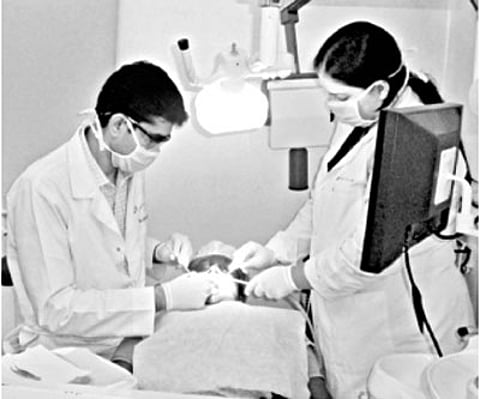

Life expectancy is increasing, and people are also looking to have a better quality of life. Our doctors are equally stretching the limits of science to treat us. Prosthodontics is the result of one such endeavour. An off-shoot of dentistry, it deals with treating and rehabilitating patients who have oral defects. Eg: artificial teeth, reassigning smiles, fixed or removable dentures with prosthetic substitutes.
What is prosthodontics?
Dr TV Padmanabhan, HoD of prosthodontics at Sri Ramachandra University, Chennai, explains, “We give cosmetic replacements for ears, eyes and nose to those who have been in accidents.” One may easily confuse this for plastic surgery, but Dr Padmanabhan is quick to clarify: “Prosthodontics is different from plastic surgery as skin grafts or original body tissue are used to replace the loss in plastic surgery. But in prosthodontics we use a prosthesis to do the same job. This is only cosmetic and has no functional value.”
There’s a lot of demand for such prosthesis. As Dr B Arun Kumar, a Chennai-based prosthodontist, says, “People are looking to have a better quality of life and wish to look as normal as possible after an accident. This is where we come in.” Adds Dr Padmanabhan, "We understand people need to look normal for society to accept them. Therefore it is important they have a ear, nose, eye or teeth so that they do not face rejection or become depressed. We use flexible silicon, zirconium, etc to create the prosthesis.”
Educational qualifications
To become a prosthodontist, one has to undergo the stipulated 4+1 BDS course and then follow it up with a PG degree in prosthodontics. “Nearly 160 institutes in India offer this course. If you wish to work in the field of rehabilitating ears, eyes, nose or other maxillofacial tissues, then you will have to take up a certificate course. They can be completed in three months to two years,” says Dr Padmanabhan.
The Tata Memorial Hospital, Mumbai, offers an 18-month certificate training course in maxillofacial prosthesis. The MA Rangoonwala College of Dental Sciences and Research Centre in Pune also offers a short-term clinical certificate course in oral maxillofacial prosthetic reconstructions.
There are many specialisations in the field of dentistry and BDS students are given an introduction to prosthodontics. “Students should decide in their second or third year as to what specialisation they wish to pursue,” says Dr Padmanabhan. Dr Kumar’s word of advice to aspirants is that they should get associated with a dentist with multiple specialties and use this time to decide what they wish to pursue.
Aptitude
Prosthodontists need to have good people skills. “Communicating with the patient to understand his needs and delivering exactly what the patient asks for is at the core of this profession,” says Dr Kumar. For Dr Padmanabhan, just communication skills will not do. “There are some concepts like beauty, colour and texture that one has to be clear about. These are extremely important when it comes to creating a prosthesis. One should not be able to tell a prosthetic replacement from an original body part. There are other skills like dexterity of the hand. This can be developed over a period of time, but your concepts have to be clear before that. You must be able to mix the right colours to get the right shade of white for the teeth.”
Walkthrough
Dr Padmanabhan tells us what exactly prosthodontists do when a patient comes to them. “We first diagnose the patient, then discuss the treatment and suggest a suitable plan. We must keep in mind that this is a prosthetic implant, so it has a life of 7-10 years and suggest the best option. The treatment involves a bit of surgery which most prosthodontists do themselves, but if the process is complicated, we seek assistance of an oral surgeon or a periodontist,” he says.
Opportunities
In India, 60 per cent of our geriatric population have oral problems and all these people have to be treated. “We also get a lot of middle-aged patients who are just beginning to lose a few teeth and need to have the functionality of the teeth for longer,” says Dr Padmanabhan.
There are two ways by which you can enter this profession — teaching and private practice. “As a BDS graduate, you can head to any of the teaching hospitals to gain experience. You can work as a research associate during this time. You can expect a salary of `8-10,000 per month,” says Dr Padmanabhan. He adds that if you are practising after completing a PG degree in a hospital, you can could earn `30,000 per month and you have the option of setting up a private practice. Dr Kumar estimates the remuneration of a practising prosthodontist at a teaching hospital at Rs 30,000 per month.
— susmita@newindianexpress.com