
When I was asked to write a profile of Asian College of Journalism (ACJ), Chennai, the things that I could conjure up were — sleeping late, waking up just on time to reach morning classes, skipping breakfasts or lunches, working on story ideas and many assignments. With jam-packed trimesters, neck and neck deadlines and need for strong nerve to tackle stress, ACJ is not your regular college.
Always prepared
“The structure of the course is one-of-a-kind. The modules are tightly packed. You would know you are doing well right from the beginning,” says Nishtha Grover (2010-11 batch), who is working with Financial World, New Delhi. ACJ offers a postgraduate diploma in journalism with specialisation in new media, print, radio and television.
I remember the first day as nearly 120 students stared at AP Shah, the then chief justice of Madras High Court. He was to deliver the inaugural lecture on key issues in journalism. Just before his speech, we were told, “Take down what the speaker is saying, a question may be asked in the exam.” Thus, we journos learnt the requisite of taking notes.
Trademark courses
The other core courses include reporting, writing, and editing; tools of the modern journalist; media perspectives and the media, law and society. Students also learn, at a basic level, to produce a TV news show, cut a radio package, simulate a page production and make a website.
The second and third trimesters are where students specialise in their respective streams. Along with the regular module, students in TV stream also have to clear a 12-week BBC Worldwide course, in which a BBC journalist would train students in two batches — one in each trimester. Through the second trimester, students are given theoretical understanding for ACJ’s trademark course — Covering deprivation. In this regard, in January 2008, our batch, which was divided into five groups, was taken on nearly a week-long trip to Gadchiroli, Wardha, Cuddalore, Kancheepuram and Krishnagiri.
Print vs TV
In the third trimester, apart from the regular stream work and electives, students need to work on an investigative report and a dissertation of 5,000-8,000 words. “Around first week of April, the placements begin. For the past couple of years, bulk of the placements was in print media and the jobs in television depend on the market condition,” says Bindu Bhaskar Balaji, the dean and faculty in new media stream. “In the West, the print media is in crisis and online media has been forced to innovate. But, Indian print media is growing. Online media, here is growing but at a certain pace.”
“Opportunities in radio journalism are almost non-existent other than in All India Radio. Most of the radio students go to print or TV. At present, private radio stations are not allowed to broadcast news,” says Sampath Kumar, faculty of the radio stream.
Shifted avenues
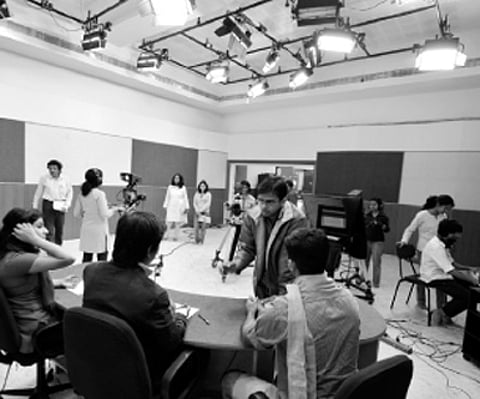
In 2000, the Media Development Foundation (MDF) took over the college from BD Goenka Foundation and shifted the campus from Bangalore to Chennai. The college campus was shifted from Anna Salai to Taramani in mid-2009. The new campus houses the college complex and residential blocks. The college complex includes nine computer labs, two digital TV studios with multi-camera shooting floors and a digital radio studio.
“There were only 65 students in the first batch (2000-01). Most of them had joined the college seeing names of Sashi Kumar, chairman of the college and other trustees of the MDF,” says Sreekumar Menon, faculty of print media stream.
The new batch (2011-12) would have about 160 students. “Today, there are students not only from the metros but also from other countries (especially SAARC countries) and other parts of the country,” says Balaji.
— mytra87@gmail.com

