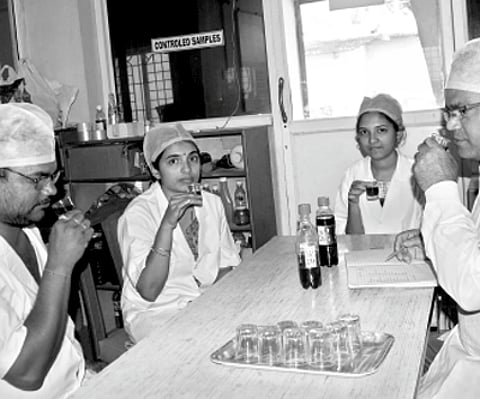

The art of engineering flavours is not an easy one. However, there isn’t a more interesting, enviable and a thrilling profession where you have the luxury to experiment and create something new every day. You not only derive ample satisfaction, but also gain a handsome salary, provided you are good at it!
As a food flavourist, you would be responsible for the tangy-spicy-sweet-tinglings on our tongues while we finish off a packet of chips, a bowl of soup or a bar of chocolate. Better known as food technologists, you will be creating the convincing flavours in our confectionaries, various beverages and the over-the-counter, ready-to-make soup powders. Flavours are added to a large number of products including toothpastes, paints, beverages, processed and frozen foods, snacks and confectionary items. However, the profession requires more than just sniffing vials and taking notes inside a lab as you try to create the perfect coffee blend or a vanilla ice cream for that matter! “The job of a food flavourist is to combine art and science,” says Ravi Mehra, CEO, Rupins, a Mumbai-based flavour manufacturing company. Hence, the art of making flavours for the food industy is steeped in a bit of mystery, science, food technology, and some inspiration.
The job
A food flavourist needs to have a deep understanding of various parameters while blending to get the desired flavour, because the job is not just about mixing different ingredients. Academic requirements for the profession are varied. A degree in biochemistry or chemistry is important. A basic knowledge of food technology will help. It is pertinent to understand that flavours behave differently in different media. “Knowledge of fine organic chemicals, essential oils and above all, common sense is necessary to become a food technologist,” says Pandurang Naik, co-owner of Mallikarjun Agro Aromatics, a leading manufacurer and supplier of food products in Karnataka. “R&D and experimentation is an important part of the job. We need to know the taste — both the physical and the chemical characteristics of the ingredients that we use. Apart from the quantity, the quality and the behaviour of the various chemicals, temperature plays a significant role in formulating a flavour.”
“A flavourist should also be a cook who experiments with his flavours,” agrues Mehra who lays emphasis on the fact that it is important to know what the flavour would eventually taste like, before designing one. “One should be able to smell and taste the food, because it is by imitation that we learn. You have to have it in you,” adds Mehra.
Tantalise the taste buds
Flavour is the essence of life. It may not satiate one’s hunger but it definitely adds to the variety. In the food and beverage industry, flavour is an important aspect that keeps customers happy and have them coming back. As Mehra puts it, “We don’t go to the same restaurant every weekend, because in doing so, the basic motive of seeking variety is lost.”
Most spices and condiments are not added for their nutritional value, we largely use them for their strong flavours. There are three categories of flavouring substances — 1) natural flavours obtained exclusively from vegetables (eg black pepper); 2) nature-identical flavouring substances. These are usually isolated from aromatic raw materials or obtained sythetically and are chemically identical to substances that are present in natural products; 3) artificial flavouring substances — substances which have not been identified in natural products (eg kala khatta, a substance which gives a tangy flavour).
Challenges
The most challenging aspect of the profession is ensuring the finished product meets the standards prescribed by the Indian government. One has to design a flavour, which would be accepted by the masses, and is edible. Stiff competion in the industry, quality, price and service are also important factors in the creation of a flavour. According to Naik, approvals and licences from PFA (Prevention of Food Adulteration) and FDA (Food and Drug Administration), are required to manufacture different flavours.
Benefits
“A flavour can create an empire or destroy it,” says Naik, who has over 20 years of experience in the industry. He was referring to Coca-Cola, which is famous worldwide for its recipe. “When your product is good, it will sell in the market and people will pay for it,” adds Naik, who loves the challenge of creating something new every day.
Sector scan
According to Mehra, flavouring is a `1,200 crore industry in India and there are around 225 flavour manufacturers in the country. He says, “The flavouring industry is concentrated in north India and Gujarat — 75 per cent of the 225 companies are based there. Gujaratis are fond of gulping down juices. Even small shops manufacture their version of flavoured drinks. A good number of food flavouring companies have their origins in India. They constitute around 75 per cent of the industry in India while 25 per cent are MNCs. Also, there are just about 12-15 flavourists who are actually involved in making flavours in India.”
Growth chart
India has the potential to become a hub given the fact that it is home to a lot of natural ingredients like cinnamon, cumin, coriander and many other spices. “Indian players in the flavour industry don’t match international standards, but there is a lot of scope for improvement,” says Naik.
Mehra echoes Naik’s sentiment. “Clearly we do not have the manpower to take this industry further. We don’t get too many food flavourists and not many are setting up manufacturing units of their own either. People have to notice the scope this industry offers. Indian tastes are varied and with the changes in the demography, one can make it big, if s/he is willing to experiment,“ he says.
What ails the industry
The Food Safety and Standards Act, 2006 lists flavours under ingredients, but ideally they deserve a separate classification. In USA, there are three classifications: active ingredients, added preservatives and colours/flavouring.
Whenever the ingredients are imported, they are tested by the customs office to check if they are fit for human consumption. However, a major part of the substance is lost in the process of testing, which according to Mehra, negates the purpose of importing ingredients.He says, “If I import a kilo of a flavour, then half of that is wasted in lab tests. Hence, we incur losses in the process. Also, if they test raw flavours, they are surely not fit for human consumption in that form. They have to undergo some more processing and mixing with other flavours to take a palatable shape.”
In India, only eight of the existing 32 food colours are allowed to be used. India imports these substances as they are not manufactured here. “We have rice belts all across the country. Vanillin, which is a primary component in vanilla bean, and is used extensively in the flavouring industry can also be extracted from rice bran. But we have not done anything to use this great resource,” says Mehra. He also rues that in India, fruit and vegetable wastes are not being utilised to generate flavours. “Simple wastes like orange peel, from which you can extract oils are just dumped. We in India are only flavour blenders, manufacturing the raw material is something we are yet to do,” he says.
Career as a flavourist
One can start a career as a food flavourist by joining a flavour house. After gaining some experience, you can start your own flavour manufacturing company, says Mehra, whose grandfather innovated the kala khatta flavour and has recently created an aam-flavoured papad.
In USA, aspiring flavourists must undergo seven years of post-baccalaureate training before they become certified flavourists. Typically, they work as lab assistants for a couple of years, performing general lab tasks and developing flavours under supervision. Once they complete training, they can apply for apprentice membership with the Society of Flavour Chemists, New Jersey, USA. However, in India, there isn’t any certificate programme offered by any university or college. No government body for that matters even certifies a flavourist. “Chemists who are experimenting don’t need any certificate to practice,” says Naik, who also mentions that a general BSc or MSc degree in chemistry is all one needs along with experience in the industry to start a career in this field. Central Food Technological Research Institute, Mysore, offers various short term courses and opportunities for R&D involving food flavouring. The department of plantation products, spices and flavour technology engages in R&D activities in areas of spices, coffee, tea, cocoa, natural food colours and flavours.
A fresher in the industry can earn anywhere between Rs 10,000-Rs 15,000. “Depending on his calibre and experience, and, of course, his capability in blending various flavours, a senior flavourist can earn upto `1 lakh,” says Naik. ■
—prerna.c@newindianexpress.com
—susmita@newindianexpress.com