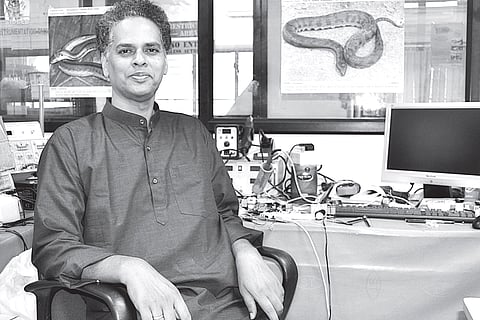

Achuthsankar S Nair, HoD of computational biology and bioinformatics and the director of State Inter University Centre of Excellence in Bioinformatics, University of Kerala, prefers to be called an ‘interdisciplinarian’. With experience in various fields — engineering, applied science, social science and fine arts — he likes to apply techniques of one discipline on another.
Nair completed his BTech and MTech in electrical engineering from College of Engineering, Thiruvananthapuram, and IIT-Mumbai respectively, an MPhil in computer speech and language processing from University of Cambridge, UK, and a PhD from University of Kerala.
Nair believes interdisciplinary pedagogy will be a key approach in the future than the traditional way of compartmentalisation of subjects. It would be an option for those who identify the possibilities of the modern world, think out-of-the-box and know their worth so as to exploit creativity.
“Universities must start looking upon themselves as factories of knowledge and students and researchers would be knowledge soldiers. When knowledge soldiers become active, a turbine of knowledge to transform our economy, society and the world itself would evolve,” says the 48-year-old. By 2050, he envisages India to be the most influential knowledge society in the world.
His conviction in inter-disciplinary pedagogy has helped Nair hold the fort when the University of Kerala began a course in bioinformatics in 2005. A lot of questions arose on how to define bioinformatics (Nair describes it as a marriage between biology and technology). One was on the eligibility of the person to guide researchers, as no one had a PhD in bioinformatics then. “It was difficult to argue. But for every new subject, the first research scholar would have got supervised by a research guide without a doctorate on that subject. Hence I took it as a logical joke,” he says.
Under his guidance, 14 candidates have successfully completed their research programme so far. He is also a satisfied HoD as his department now offers MSc in computational biology and two MPhil courses — bioinformatics and computer-aided drug design.
Nair is a votary of the gurukula system, where teachers consider students are their own child — he plays shuttle with the students, goes on walks and has tea with them. “The teacher has to carefully be friendly with the students. They should not be as close as they will lose the gravity to manage the learning process. A distance of 1 feet is ideal to ensure the good of the students. To play the role of a guide, a small distance and a slight unpredictability is fine. In addition to that, the teacher, in his/her mind should treat the student as equal,” he explains.
Under the initiative, ‘Trees for 2100 AD’, he has planted the sapling of a banyan tree on the Kariavattom campus in Thiruvananthapuram. “Even though the teachings and research at present may turn irrelevant in 100 years, what we have contributed to nature will exist. With the energy crises coupled with mismanagement of environment, to sit under a fan or an air-conditioner may not be possible in those days. By the time, the banyan tree would have grown taller, spread its arms and become a relevant presence in the campus with its cool shade,” says this green-fingered academician.
He also advocates erecting temporary or semi-permanent structures instead of huge concrete buildings. He has thus erected an eco-friendly classroom and fondly named it Haritharatnakaram. The floors have been plastered with cow dung. Bamboo pillars and a thatched roof complete Haritharatnakaram. “Resources need not have to be used unnecessarily for making permanent structures. If a building was constructed in the place of this eco-friendly classroom, it would not have touched the hearts of people. In all these years, the most memorable lectures of mine have happened inside it,” he says.
An avid lover of Carnatic music, Nair has created a ‘gene music’ composition by mapping DNA. The work is done in Kalyani ragam. Also, he has penned several books on information technology including a science fiction novel for children — Idichakkaplamoodile Rajakumari Thanthram Padichathengane.
His research publications have appeared in both Indian and International journals. He has also taught in various engineering colleges and universities in India and abroad in a career spanning 25 years.
meera.manu@newindianexpress.com

