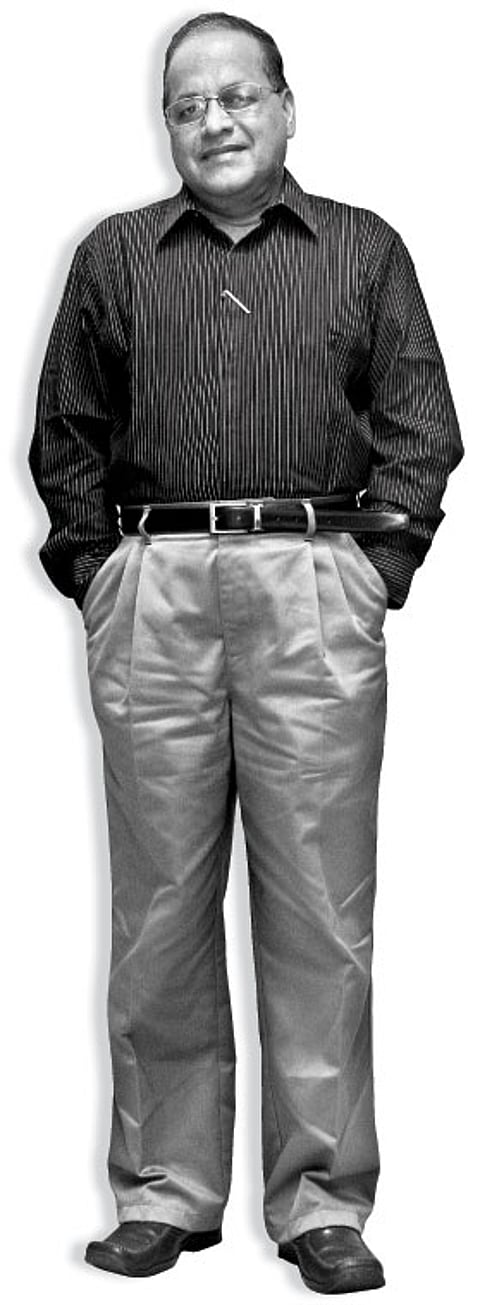

B Madhusoodana Kurup, vice-chancellor of Kerala University of Fisheries and Ocean Sciences (KUFOS), Kochi, was born in a middle-class family in a remote village near Madavoor, Thiruvananthapuram. “Very few people in my village had access to college education then. I was fortunate to be one among them,” says the 58-year-old.
A study tour to Mandapam, Rameswaram, Tamil Nadu, during his BSC zoology days changed his life. In Mandapam, Kurup visited Central Marine Fisheries Research Institute, and the pristine beauty of the aquatic life there inspired him to pursue marine biology, though the convention then was to become a doctor. “I graduated in zoology. Then, the top scorers in BSc zoology used to study MBBS. I also qualified for MBBS. Pursuing MBBS was considered highly prestigious then. I was under tremendous social pressure. But I decided not to go by social pressure and pursue my passion instead. Unfortunately in our society, there is a tendency to superimpose the decision of parents on students,” he says.
Fishy tale
Kurup completed his MSc in marine biology from Cochin University of Science and Technology (CUSAT) in 1977. He went on to read for PhD at School of Industrial Fisheries in the same institute. His thesis was on ‘Systematics, Ecology and Fisheries of Vemabanad Lake’, which was supervised by CT Samuel, former director of school of industrial fisheries, and was submitted in 1983.
Soon after Kurup joined College of Fisheries, Kerala Agricultural University, as junior assistant professor. He was selected as reader in the School of Industrial Fisheries, CUSAT, in 1992. In 1998, he became a full-fledged professor of CUSAT and in 2008, was appointed as director of the School. He did his postdoc at Wageningen University, Netherlands, in 2004. He also worked briefly for Aquaculture and Fishery Science Institute, Cantho, Vietnam.
Kurup, who in 2010 was appointed as VC of KUFOS, the first fisheries university in India, believes there is no shortcut to success other than hard work. “I come from a relatively humble background. I did not have much social capital. My capital was hard work. Sincerity to my passion and hard work helped me climb the ladder of academics. It is crucial to develop the habit of hard work right from childhood. Even if a student is brilliant, they may not be able to reach their destinations if they are not hard working,” says Kurup, who has guided 20 students with their PhD research. “I ensure my students go through tough training. I’m very strict about quality of work as well as completing the work in a time-bound manner. Initially, many students may find it difficult to adjust to the rigorous routine but once they are sucked into that work culture, they will excel. They will have the capacity to produce work with an international stature,” he says.
Lend a hand
The vice-chancellor attaches a lot of importance to the use of knowledge to create progressive changes in society. “I was extremely happy when my postdoctoral research helped shrimp farmers in Kerala,” he says. His research has contributed to addressing ecological problems associated with shrimp farming. It also helped in bringing down the cost of the feeds. He believes “we should develop green technologies to decrease carbon footprints. At the moment, fishing pressure is two to three than the required level so it is high time we reduced fleet capacity. Destructive types of fishing like bottom trawling should not be encouraged. Invansion of certain exotic fish can damage biodiversity. Governments should be really careful about it,” he says.
Kurup initiated several positive changes in the fishing sector when was an advisor to S Sharma, minister of fisheries and registration, Kerala, from 2006 to 2011. He was also awarded Marie Curie Actions Fellowship of European Union under the Seventh Framework programme.
Kurup rues the fact that the country is losing a lot of talent to engineering when we are “facing a severe shortage of researchers in pure sciences. In fact there are plenty of opportunities in pure sciences. But students are under huge social pressure to go for engineering courses,” he says.
Achievements
Kurup is busy introducing innovations in KUFOS. According to him, a major handicap of the Indian education system is not creating a culture of entrepreneurship and Kurup is all set to change this in KUFOS. “I’m inspired by the experiments in China. Chinese fisheries universities are converting knowledge into wealth at a massive scale. India has a huge potential in aquaculture. We are encouraging our students to come up with projects in aquaculture, which will promise them a decent income,” he says.
Kurup lives with his wife Dr Jayashree, a gynaecologist, in Kochi. His son Ramesh is an engineer and daughter Reshma works at Amrita Hospital here. He loves to play badminton and often listens to music.
— edex@newindianexpress.com

