
One would imagine that social activist Sunitha Krishnan would be in the highest of spirits considering she is the first Indian and Asian to bag the coveted Nelson Mandela Graça Machel Innovation Awards given for social work announced last month, but that is not the case. “Everyday I counter so many obstacles. While on one hand, my work is being appreciated with such awards, on the other hand, I have to deal with my detractors, who constantly try to threaten me and my staff, and disrupt the functioning of my NGO, Prajwala. And then, now you have the Pakistan school massacre. This is the most shameful act I have seen in recent times. It is painful that innocent children are being made pawns to pacify a reign of terror. It is disgusting and absolutely unacceptable,” her voice shakes with anger at the other end of the line. She is the recipient of innumerous awards including Mother Teresa Award for Social Justice, Anita Parekh Award For Women’s Empowerment and Akruthi Woman of the Year Award. She has also given a number of talks including TedX.
Started in Hyderabad in 1996, Prajwala works towards rescuing and rehabilitating victims of sex trafficking and has, so far, rescued about 10,000 survivors. Sunitha, herself, is a gang-rape survivor. “I am not sure if I am living in a fool’s paradise, but every single day I dream of a world where women and children are safe and that is what drives me. But recent incidents like the Delhi Taxi rape and Pakistan School attack has been making a mockery of my convictions. We hold a glittering function and award Malala Yousafzai for her efforts and the next thing you hear is children being killed in the country she hails from,” she says.

While the gang-rape was horrifying (when she was about 15, she was raped by a group of men retaliating against a literacy campaign she was conducting), Sunitha says that the same gave her impetus to work with renewed vigour on Prajwala. “Brother Jose Vetticatil, a missionary, gave me the much-needed support at the time. But wherever I go, people think that this particular incident has acted as a catalyst to what I am doing now. I was into social activism as a kid, I would have done it anyway. It is not like every sexually assaulted survivor becomes an activist, and the ones who were not don’t engage themselves in humanitarian work. But of course, the horrifying incident did give some clarity and helped fuel my anger in a constructive manner,” she says.
Sunitha has a Bachelor’s in Environmental Sciences from St Joseph’s College, Bangalore, a Master’s in Social Work from Roshni Nilaya, Mangalore, and a PhD in Social Work from Harvard University, US. Her PhD thesis was on the life of sex workers. She is also the author of Caregiver’s Manual on Sex Trafficking: A guide to Creating a Healing Space to Restore Dignity for Victims; From Despair to Hope: A Handbook for HIV/AIDS Counselors; Living Positively: A Series of 8 Resource Guides for Barefoot HIV Counselors on Community-Based Care & Support; and Handbook for Anti-Trafficking Partners of Andhra Pradesh: A State Resource Directory of Service Providers.
Sunitha has been involved in a number of drives for change during the course of her life, including the ‘Real Men Don’t Buy Sex’ campaign, but asserts that making prostitution legal is in no way going to stop rape, sexual trafficking and related crimes. “Prostitution per se is exploitation. I see people often opining that prostitution should be legalised. Are you telling me that the State will open brothels and pimps will live without an ounce of fear of police intervention? Legistimising rape is not the solution.”
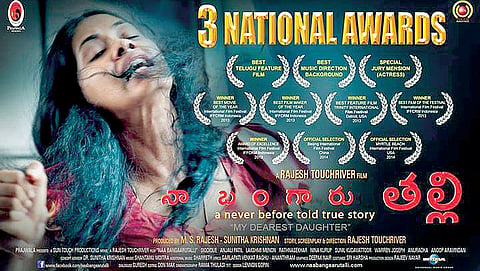
In order to get her message across about sexual trafficking, Sunitha and her director husband Rajesh Touchriver have also explored the celluloid medium. Naa Bangaaru Talli (My Dearest Daughter, released in Malayalam as Ente), a Telugu film which the duo collaborated on, has bagged three national awards and is having a successful fifth week at the cinemas. “People think that such ‘artistic’ films don’t reach the masses. But from the reports I have got, it is the so-called multiplex audience whose interest in the film has dimmed while single screens are doing very well. All this, despite us hardly engaging in the publicity for the film.” Some of the other films that she has worked on include Anamika — The Nameless, The Sacred Face, Bhagnagar and A Chance to Live.
While threats and attacks are almost an everyday feature in the self-confessed feminist’s life, she is, much to the displeasure of her critics, delighted that she is targeted. “I thank these people from the bottom of my heart and I wish could send them some flowers. Like the men in my life — Rajesh, my father Rajakrishnan and Brother Vetticatil — they too have contributed to my success. These interventions, though being inconvenient, are proof of my success and the right path that I am on. Until every woman and child is safe in the country, my journey won’t end and I will die fighting if that is going to be the final outcome.”
— shilpa.vasudevan@newindianexpress.com
