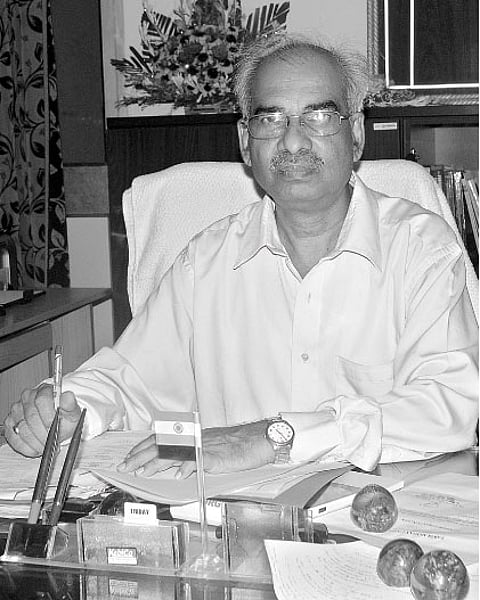

BALASORE: Having joined barely three weeks ago, Vice-Chancellor of Fakir Mohan University, Balasore, Odisha, Prof Siba Prasad Adhikary dreams of taking his young institution to greater heights. As an academician with nearly 34 years of teaching and research experience in the university system, Prof Adhikary’s primary objective is to help his students achieve academic while inculcating in them values like honesty, integrity, punctuality and commitment.
“My major focus, besides developing and popularising education, technology and culture, is to publicise the work and contribution of Fakir Mohan in the national and international arenas, which would be a fitting tribute to this great son of the soil,” he says. Fakir Mohan Senapati is regarded as the father of Odia nationalism and modern Odia literature.
A biotechnologist, Adhikary received the young Scientist Award of the Indian Botanical Society in 1983 during his formative years in research. Born into a poor farmer’s family in Maniakati village in Surada block of Ganjam district, money never interested him. The world of science looked fascinating during his college days and research became a way of life. He was awarded gold medals in BSc Honours and MSc in Botany. He obtained a PhD in 1980 from Berhampur University and a DSc degree from Utkal University in 2000, becoming the first to receive the DSc in Botany.
Before joining the Biotechnology Department in Visva-Bharati Central University at Kolkata, he headed the Biotechnology Department of Utkal University in Bhubaneswar from 2002 to 2008. “In fact, I started the department in Visva-Bharati from scratch. We pursued it all the way and now it is one of the best departments. It is a nice place of culture, and I learnt a lot. When you get to have discussions at an academic level with people of high thinking, you get refined,” he says.
Prof Adhikary was initially not keen to get into administration. “But I know the situation in Odisha where I had worked for 23 years. I was really worried about the state of the education system. Colleges are without teachers and the curriculum weak without upgradation. Students are more interested in getting into engineering and give basic courses the short shrift. Education is not limited to Science, Arts or Commerce, it is more comprehensive. It should include art, culture, music and dance, and everything should come together to form the basis of the education system. When I saw the vacancy advertisement, I thought why not go to Odisha and do something. Then things went on very well; I applied and got selected,” he laughs.
A research-oriented person, Prof Adhikary, believes Biotechnology is a very expensive subject. “One gram of chemical will cost you `10,000-20,000 and it requires highly expensive equipment and consumables. Plus, you need expertise. Biotechnology is not like IT. Everybody says that Biotech fetches an instant job, but that is not true.” The professor’s principal research interest is bio and organic fertilisers from marine algae (seaweeds from Chilika lagoon) for various crops and extending the technology for the benefit of farmers in rural areas of eastern India. He has also documented groups of microorganisms from glaciers of Northern Sikkim and Alpine lakes of Arunachal Pradesh, Majuli and Kaziranga of Assam, Loktak lake of Manipur, and the Indo-Burma hot spot region of Nagaland and Mizoram, besides fish ponds of Tripura and the wettest places in Cherrapunji of Meghalaya.
He has a laboratory in his native village where he produces biofertilisers and has been giving it to farmers free of cost since 1999. His R&D work on biodeterioration of stone monuments of archaeological importance in India for the past two decades has been a pioneering contribution in this part of the globe — this project achieved international significance by way of an MoU with University of Rome, Italy in 2008.
He believes doctorates are the show pieces of a university. If the PhD’s quality is good, the university will grow, he says. “My target is to make the academic atmosphere more conducive. I want to introduce a non-credit course on Fakir Mohan. All students who join the University will have to study about Fakir Mohan, his contemporaries and their literary works and creations. I will make it in such a way that it can be studied as comparative literature. I have also planned to celebrate two annual functions for seven days during the birth and death anniversaries of the legendary novelist,” he says.
Prof Adhikary also wants to identify a few villages around to take technology to them. “If possible, I will develop some rural technology. NGOs and SHGs can be involved and be of help to use the technology to become self-sufficient through different government-sponsored programmes. If a university does not have a human face, it is not a university. Not only agriculture, I also want to focus on aquaculture. I also want to set up a biotech laboratory here,” he explains.
Staff crunch is one of the major challenges Prof Adhikary has been facing. “Things here are mostly run by outsourced persons from whom no accountability can be expected. The permanent non-teaching staff, few in number, are hard pressed. The library is not up to the mark — highly disorganised with computers and gadgets that don’t work properly. I am engrossed in files, RTI applications and court cases. A university should not be involved in irregularities. It should be transparent because it deals with students. My target is to put the house in order soon and start working for the overall development of the varsity,” he says.
The University named after Fakir Mohan, ironically does not have a full-fledged postgraduation course in Odia. MCA, MBA and CA are perceived as safe bets for students to land jobs. “But the purpose of a university is not to provide jobs. It aims to educate people. It has to teach every basic course in addition to the job-oriented ones. I would try to incorporate these in the university and I think I will succeed. I believe I can succeed only for my students, who are my strength.”
Heritage and monuments are as close to his heart as Biotechnology. During leisure, he reads books, mostly biographies and writes science-related articles. He has a library at his Bhubaneswar residence full of scientific books, journals, biographies, mythological and spiritual books and bestsellers.
— hemant.kumar@newindianexpress.com

