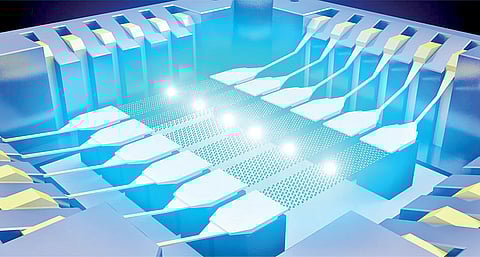

Graphene, a wonder material that has many extraordinary properties including being 200 times stronger than steel by weight, found another use with the creation of the world’s thinnest light bulb from it, courtesy a collaboration between mechanical engineers from the US and Korea.
Researchers attached small strips of graphene to metal electrodes and managed to pass a current through them, causing them to heat up. This is the first time ever that graphene has been used to create a filament for an on-chip visible light source, as validated in the journal, Nature Nanotechnology.
By using Graphene, which is a structural modification of carbon, researchers are essentially working with exactly the same materials as Thomas Edison was when he created the incandescent bulb. “Edison originally used carbon as a filament for his light bulb and here we are going back to the same element, but using it in its pure form — graphene — and at its ultimate size limit — one atom thick,” said Yun Daniel Park, co-lead author of the study from Seoul National University in an interview to wired.co.uk.
“We’ve created what is essentially the world’s thinnest light bulb,” the website quoted James Hone, from Columbia Engineering as saying.
Describing the bulb as “a new type of ‘broadband’ light emitter”, Hone said in the report that if it can be integrated into chips, “it will pave the way towards the realisation of atomically thin, flexible, and transparent displays, and graphene-based on-chip optical communications”.
The going was not smooth though. Researchers found out that when putting forms of light onto the incandescent filament bulb, it tended to reach temperatures of thousands of degrees Celsius and transfered heat easily to the surrounding areas, which would damage the chip.
Graphene, was no different to this as well as measuring light from it, researchers found that that temperature soared to 2,500 degrees Celsius.
“The light from atomically thin graphene is so intense that it is visible even to the naked eye, without any additional magnification,” Young Duck Kim, the postdoctoral researcher who led the study, was quoted as saying in the article.
The silver lining was the fact that graphene was a poor conductor of heat and allowed the heat to remain in one specific spot alone.
Now that graphene light bulbs have become a reality, researchers are next faced with the task of working out how fast they can be turned on or off, knowledge that would be vital for using them in fibre-optic communication.
“We are just starting to dream about other uses for these structures — for example, as micro-hotplates that can be heated to thousands of degrees in a fraction of a second to study high-temperature chemical reactions or catalysis,” Hone is quoted as concluding in the report.
Compiled by Shilpa Kappur Vasudevan, shilpa.vasudevan@newindianexpress.com