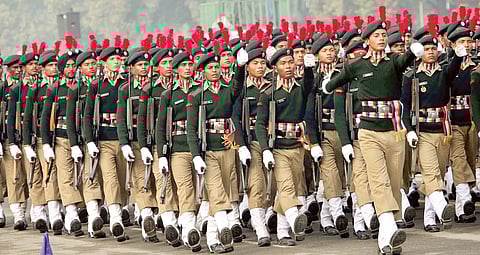

Captain (retd) Smita Gaikwad has had an interesting life, with experiences ranging from serving the nation as part of the Indian Army, to currently working as a social worker with Janaagraha, an NGO in Bangalore. “I graduated from Fergusson College in Pune. I was a part of the naval wing of the National Cadet Corps (NCC). I had always enjoyed adventure sports like trekking and biking, and also going on long drives. But my dream was to join the Army. I joined the Army for sports, adventure, travelling and, of course, to serve the nation,” says Smita.
Smita says her decision to join the Army was a non-issue in her family. “I was never told I should or shouldn’t do something because I’m a woman. Hence, I never understood gender discrimination or inequality. I used to wonder why people still talk about women empowerment,” she recalls.
Recalling her experience in a male bastion, she says, “I got commissioned in 2004 into the Corps of Engineers, and being in a regiment was a different experience; we were like family. It is a male-dominated profession and you need to prove yourself every time. Once you do that, the Army accepts and respects you. But it’s not just in the Army, this mindset is everywhere. In any profession, women have to prove themselves. People have certain ideas of what women are capable of and what they are not. When you prove yourself, it breaks stereotypes and you get accepted.”
Speaking of how the Army made her realise her potential, she says, “The training makes you extend yourself beyond your limits. It is about will power and what you believe you can achieve. Being a sportswoman with an NCC background, I was prepared for the training both physically and mentally. Yet, there comes a time when you want to give up. That is when you learn how not to give up. The Army teaches you perseverance and team work,” she says.
Recalling her days when she was stationed in Assam, Smita says it changed her perspective. She saw girls having to struggle for basic rights such as playing a sport. “During one of our missions, we developed goodwill and trust among villagers by organising games and events for them. During one such volleyball match, a few girls asked me if they could play. When I complied, the saree-clad girls went to change into comfortable attire. But by the time they could return, the sarpanch of the village, on learning about the developments, informed me that he wouldn’t allow the girls to play. But I stood my ground, and he had to give in.”
Smita retired from the Army in 2009, as there was no permanent commission, and she wanted to actively get into social service. She did a six-month management course at IIM-C meant for resettlement of officers. “That is the beauty of the Army. It also cares about the resettlement of a retired officer. After the course, I joined Cummins India Ltd in the HR department, which was another life-changing opportunity. I got an assignment in a green field project of Cummins in Phaltan, 100 km from Pune. The best part was that I had a role in the gender diversity initiative that Cummins started on the shop floor, which was until then another ‘male bastion’,” she says.
Speaking about the transition to social service, Smita says, “After my stint in Cummins, I shifted to Vodafone, Gujarat. Thus, I spent five years in the corporate sector. However, the urge to be a part of the social sector made me feel restless. Stepping out of my comfort zone and giving up financial stability was not an easy decision. But, I decided to listen to my inner voice, and joined Janaagraha, where I am currently responsible for two projects — Community Policing and PURE (Proper Urban Electoral List). This has been another turning point. I am passionate about working in sectors related to governance and leveraging women empowerment for nation building.

In her spare time, Smita sails. “The Army gave me the chance to be part of three sailing expeditions, Mumbai-Lakshadweep, Mumbai-Goa and Chennai-Rameshwaram. Such expeditions groom you as an adventure enthusiast and make you realise the strength and beauty of nature,” she says.
Her message to women: “We are humans first and only then women. It is essential to be ourselves. We must appreciate our femininity and never consider ourselves a weaker sex. It is all in one’s mind. “We comprise half of the population of the nation and the world, and have equal responsibilities in nation building, taking India forward and making the world a better place. Don’t let your gender become a hurdle in any of the decisions you take in life. You can do it all, once you believe in yourself!” she says. — akshay@new
indianexpress.com