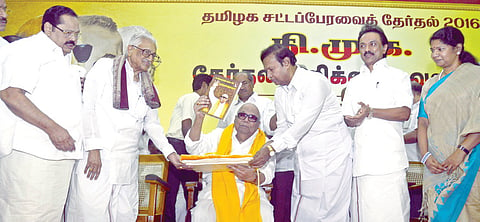

CHENNAI: The DMK, whose championing the art of freebie distribution in 2006 Assembly polls had come under severe criticism, has chosen to shun its controversial wooing method in favour of populist promises in the election manifesto released by party chief M Karunanidhi on Sunday.
In the 501-point manifesto, the party has poured in numerous populist measures, targeting farmers, women, fishermen, youth and students. The only freebie announced this year happens to be distribution of free smartphones to families that cannot afford them. The DMK manifesto too promises total prohibition, but in one go.
“We only promise what we can do; and we will fulfil what we have promised,” Karunanidhi asserted amidst applause while speaking after the manifesto release. He also released a separate volume containing promises for every district in the State. DMK treasurer M K Stalin underscored the point that the manifesto had been prepared keeping in mind the pulse of the people.
“A law will be enacted, enforcing prohibition in Tamil Nadu. The government will formulate schemes to compensate the loss incurred by implementing prohibition. The TASMAC will be wound up and Tamil Nadu Integrated Regulated Marketing Corporation will be created to absorb all TASMAC employees,” the DMK election manifesto said.
The key aspects of the DMK’s populist manifesto include reduction of Aavin milk price by `7 per litre; distribution of all goods through PDS shops throughout the week; revival of legislative council; opening of Arignar Anna Unavagam for the poor; free bus travel for differently-abled and the elderly; interest free loan of `2,000 to small-scale traders; withdrawal of all defamation cases against journalists; legislations implementing Lok Ayukta and Right to Services Act; a separate budget for agriculture; waiver of entire crop loan availed of by small and micro farmers; rasing the minimum support price (MSP) for paddy to `2,500 per quintal; hiking MSP for sugarcane to `3,500 per tonne; a separate department for organic farming; MSP for agriculture products like plantain, turmeric, tapioca, pulse millets, chilly, grains, tea, oil seeds, sesame and sunflower.
A number of points have been included to woo students, first-time voters and youth. Prominent among those were waiving educational loans of students; free laptops or tablets with internet connectivity in 3G/4G with 10GB per month for 16 lakh students studying in higher secondary schools and colleges; providing wi-fi facility at all public places; free education for first generation students joining professional courses irrespective of caste; grant of `1 lakh to registered graduate entrepreneurs to start small enterprise; converting employment exchanges into skill development instituttions.
For the weaver community, the manifesto said free power to handloom weavers would be increased from 100 units to 200, while free power for powerlooms would be increased from 500 to 750 units. Besides, 10 units of free power will be supplied to powerlooms attached to residences.
Five lakh houses for fishermen; maternity leave for government employees from six months to nine months; a separate ministry for irrigation; full subsidy for all varieties of paddy seeds; power supply to farmers who have applied for power connection; setting up a Water Management Authority; setting up of separate textile commission; steps to include fishermen community on the list of STs as marine tribes are the other key promises made in the manifesto.
The manifesto said with the involvement of two lakh unemployed youth, the government would directly undertake mining and trading of granite, minerals, sand blue metal etc.

