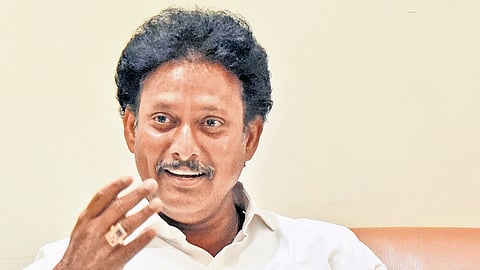

School Education Minister and Thiruverumbur DMK candidate Anbil Mahesh Poyyamozhi speaks to TNIE’s Pearson Lenekar SR on criticism over dynastic politics, teacher vacancies, concerns over learning outcomes and the three-language policy. Edited excerpts:
The DMK faces criticism over dynastic politics, with successive generations from a political family holding power. How do you respond?
Elections are decided by people, not by family background. If people don’t accept you, you cannot win. People have accepted us, which is why we have been elected. In my case, my victory margin increased from about 16,000 votes in 2016 to nearly 49,000 votes in 2021. That reflects trust in performance. This narrative has failed, but the BJP still believes it will work in Tamil Nadu. Across India, even in the BJP, there are leaders whose family members are in politics. Ultimately, only public acceptance matters.
Tiruchy East is under your district, and Vijay is contesting there. Is the DMK facing a tougher contest this time?
After filing nomination, Vijay has not visited the constituency again. Even his cadres are struggling without support. Our candidate, Inigo Irudhayaraj, walks for more than 10 hours a day, meeting people on the ground. We are confident of victory.
Despite increased funding in the school education department, learning outcomes remain a concern. Where is the gap?
We have invested around `2.63 lakh crore in school education over the past five years. We have built over 9,024 classrooms, and our target is 70,000 classrooms by 2027. Smart classrooms and digital access have expanded across 22,931 elementary schools. We have brought the dropout rate in elementary education to nearly zero, while it is around 7.7% in secondary and higher secondary levels, which is lower than the national average. We conducted a state-level achievement survey covering around 9 lakh students, focusing on foundational literacy and numeracy. Through programmes like Thiran, we address gaps in Tamil, English, and mathematics, especially among slow learners.
There is a growing preference for private schools. How do you address that?
We don’t see private schools as competitors. We have introduced over 70 schemes in government schools and even private schools are adopting some of our methods. While parents may still perceive private schools as better, we are strengthening government schools to be their first option.
Teachers continue to flag vacancies, administrative burden, and infrastructure gaps. Why do these persist?
We have recruited 12,895 teachers so far. Recruitment delays are largely due to litigation. There are over 13,000 legal cases in the department. Nearly 30% of government employees are from the school education department, so the scale itself is a challenge. Despite this, we have addressed many of their demands.
On three-language policy, what is Tamil Nadu’s position?
Tamil Nadu will continue with the two-language policy. At the same time, we are strengthening English proficiency through labs and digital tools. Our focus is on making students confident and employable without imposing additional burdens.
