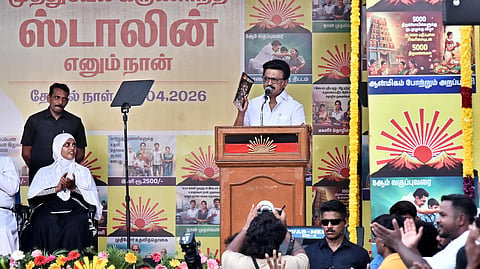

CHENNAI: Tamil Nadu’s 5.67 crore voters will march to the polling stations today (Thursday) to decide the fate of 234 Assembly constituencies. The high-decibel campaign drew to a close on Tuesday following which the state went through a mandatory 48-hour silence period ahead of polling.
What emerged over the weeks-long campaigning is a tight three-cornered contest, vastly different from the usual tradition of a two-horse race. Along with the familiar weight of two alliances led by DMK and AIADMK, new entrant Vijay’s Tamilaga Vettri Kazhagam has clearly made it one of the most layered elections that the state has never seen.
At the centre of the contest remains the Secular Progressive Alliance (SPA) led by the ruling DMK. Its president and Chief Minister MK Stalin has framed the election as a fight between Delhi and Tamil Nadu.
However, it was the AIADMK-led NDA that first began the election work a year ago. Soon after joining hands with BJP, the new-look AIADMK pitched for a double-engine government in the state.
While seat-sharing and constituency identification was almost smooth in NDA, there was a long delay in SPA. The SPA expanded with the entry of new partners such as DMDK led by Premalatha Vijayakanth, a sign that DMK was trying to cover all its bases in the event of a tight contest.

While there were differences between the cadres of alliance parties, Stalin stepped in to iron out the friction. It was towards the end of the campaign that Stalin found an unexpected opening when the delimitation controversy broke.
By articulating concerns that population-based delimitation could penalise southern states like Tamil Nadu, he tapped into a deeper and long-standing anxiety over federal imbalance, positioning himself not just as a state leader but as a voice in the national debate on federalism.
Although SPA framed the election as a referendum on governance and welfare schemes, it also stressed on federal rights. It announced the Illatharasi scheme, offering a one-time coupon of `8,000 for women heads of household, in response to AIADMK promise of a free refrigerator along with other subsidies.
On the face of it, AIADMK led by Edappadi K Palaniswami attempted a political resurgence while redefining itself after organisational and alliance shifts. The party’s biggest pre-election move was patching up with BJP. AIADMK’s strategy to release its poll manifesto in parts received widespread attention.
However, distasteful comments by party leaders dented the campaign and had a cascading effect on women voters. EPS campaigned extensively across the state, seeking to reaffirm AIADMK’s credentials to form a government and “save” the state.
The election story would be incomplete without actor-turned-politician Vijay and his TVK, which overshadowed the original ‘change-agent’ Seeman’s NTK this season. His political entry generated enthusiasm, especially among younger voters and sections of the urban electorate, positioning TVK as an alternative to entrenched Dravidian dominance.
The Karur stampede on September 27 last year was a huge setback and cast a long shadow on Vijay’s immediate political future. Nevertheless, he bounced back, moving from indoor meetings to roadshows and street campaigns.
He occasionally withdrew from multiple campaign events even after permissions had been granted by the Election Commission, drawing mockery from rival parties who branded it a “work-from-home” campaign.
Yet, when the votes are counted, it may well be Vijay who has the last word. Untested and unproven as a political force, TVK remains the biggest X factor of this election, with neither DMK nor AIADMK certain about whose vote share he will eat into more.
In a contest where margins could be wafer-thin across dozens of constituencies, the direction of Vijay’s vote swing may ultimately determine not just TVK’s fate, but the winning prospects of the Dravidian giants.