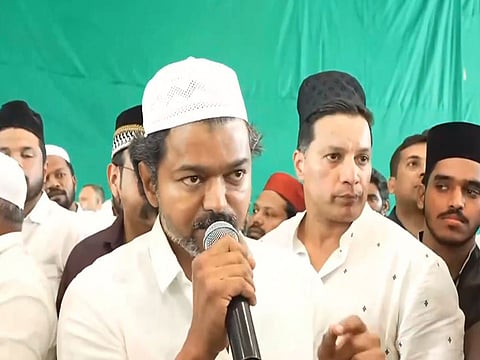

A high-energy iftaar organised by Tamilaga Vettri Kazhagam (TVK), with busloads of cadres pouring in, transformed the usually quiet coastal town of Poonjeeri near Mahabalipuram on Wednesday evening. Yet barricades, broken promises, and hidden phones defined the event’s uneasy choreography, making it as revealing for its absences and restrictions as for its intended political messaging.
Though the iftaar was projected as a gesture of outreach and inclusivity, it unfolded as a tightly regulated exercise in access control, underscoring a party still grappling with the contradictions between mass appeal and organisational discipline.
The event was deliberately limited in scale, with a carefully curated guest list and strict enforcement of entry protocols that left little room for the kind of spontaneous participation that has long defined Vijay’s public engagements. Barricades, multiple layers of screening, and a visible security presence created an atmosphere that felt less like a community gathering and more like a controlled enclosure. For a leader whose political identity is rooted in accessibility and emotional connection with supporters, the distance imposed by such arrangements was striking.
This shift did not emerge in isolation. It reflects a deeper recalibration within the party following the Karur tragedy, which exposed the risks of unmanaged crowds and forced a rethink of how public events are conducted. Since then, caution has replaced exuberance, and regulation has taken precedence over organic mobilisation. The iftaar became a clear manifestation of this new approach, where the imperative to avoid disorder has led to an equally conspicuous effort to contain and structure every aspect of participation.
Yet, the attempt to impose order has introduced its own form of dissonance. Many among those who had expected easier access found themselves kept at a distance, fuelling quiet resentment and a sense that the party’s earlier promises of openness were being diluted. The symbolism of restricted movement and tightly controlled interactions stood in contrast to the image of a people-centric political project, raising questions about whether the party can sustain its emotional connect while tightening its operational grip.
Equally telling was the effort to manage the flow of information. The handling of mobile phones and recording devices, whether through explicit restrictions or informal controls, pointed to an acute awareness of optics. The party appeared intent on shaping not just the event itself but also how it would be seen and remembered, limiting the possibility of unscripted moments or narratives emerging from the ground. In doing so, it signalled a preference for curated visibility over unfiltered engagement, a choice that may help avoid missteps but also risks eroding authenticity.
At a broader level, the iftaar was meant to reinforce Vijay’s positioning on secular outreach and social inclusivity, particularly in a politically sensitive climate. The gesture itself carried significance, but the manner of its execution complicated the message. The controlled environment, while administratively efficient, muted the sense of collective participation that such occasions typically evoke, making the outreach appear more performative than participatory.
What emerges from this episode is a portrait of a political formation in transition, attempting to move from a personality-driven movement to a structured organisation capable of contesting power. The tensions inherent in that transition are becoming increasingly visible. On one hand is the need to ensure safety, discipline, and message coherence; on the other is the expectation of openness, spontaneity, and direct engagement that has fuelled the party’s rise.
The managed chaos of the iftaar captures this tension in a single frame. The chaos lies in the overwhelming demand for proximity to Vijay, a demand that remains undiminished. The management lies in the party’s attempt to ration that proximity through systems of control that are still evolving and, at times, unevenly implemented. The result is an experience that feels neither fully open nor entirely orderly, but suspended somewhere in between.
As the state moves closer to a high-stakes electoral contest, the questions raised by such events acquire greater significance. A political movement that seeks to translate popularity into votes must find ways to scale engagement without losing credibility. The iftaar suggests that TVK is still searching for that balance. Its current model, defined by controlled access and curated interaction, may offer short-term stability but will need refinement if it is to support the kind of expansive mobilisation that electoral success demands.
In the final analysis, the event serves less as a showcase of strength and more as an indicator of the challenges ahead. It reveals a party aware of its vulnerabilities yet still uncertain about how to reconcile them with its ambitions. The barricades may have kept disorder at bay, but they also made visible the distance that has begun to open up between leadership and supporters. How that distance is managed, reduced, or reimagined will shape not just future events, but the trajectory of Vijay’s political project itself.
(With inputs from PTI)