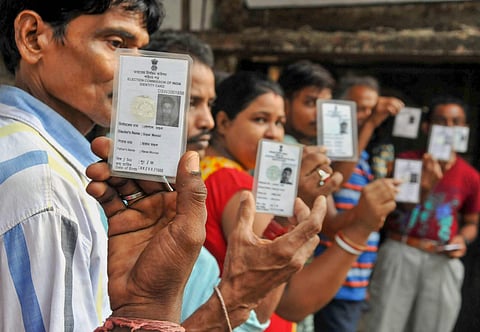

KOLKATA: Following the Supreme Court’s directives on Thursday, a key question is how many of the 27 lakh voters excluded from the final supplementary list cleared by judicial officers will be able to cast their votes in the upcoming elections across West Bengal’s 294 Assembly constituencies.
On April 16, 2026, the Supreme Court directed that voters excluded from West Bengal’s Special Intensive Revision (SIR) list must be given a fair opportunity to challenge their exclusion before competent authorities. It also asked the Election Commission to ensure due process and transparency while deciding such appeals ahead of the polls.
Assembly elections in two phases in West Bengal will be held on April 23 and 29. Following the apex court order, many excluded voters have heaved a sigh of relief virtually hoping that they could cast their democratic rights in the coming elections if the appellate tribunals give them recognition as eligible electors.
However, officials associated with the appellate tribunals and office of the West Bengal Chief Electoral Officer (CEO) expressing doubts felt that it would be very difficult to dispose of all the 27 lakh cases by the deadline April 21 and April 27. Most of the 19 appellate tribunals are yet to be functional in full-fledged manner.
Till last week, only around 15 cases among the 27 lakh names of people excluded from the rolls following verifications of documents of total 60 lakh voters marked as ‘under adjudication’ by the national poll body. Some of the officials said that each tribunal can hardly dispose of appeals of hardly 10 excluded voters every day.
After disposal of 10 cases, new appeals are considered for scrutiny. In all, the 19 appellate tribunals headed by retired judges each can solve maximum 190 to 200 cases per day. The officials could not give any clarifications on the issue till Friday, a day after the apex court directive on Thursday.
They also don’t know how much difference the court order can make in connection with prompt disposal of such a mammoth number of cases. On Thursday, the Supreme Court directed that voters cleared by 19 appellate tribunals on or before April 21 can vote in the first phase on April 23, and those cleared by April 27 can do so during the second phase on April 29.
The apex court order, relating to the April 13 hearing but formally uploaded on Thursday, relaxes the existing deadlines of April 6 and 9 for voter inclusion in the rolls for the first and second phases, respectively. The Election Commission of India (ECI) will now have to issue fresh supplementary lists for the first and second phases by April 21 and April 27, by doing inclusion and exclusion of voters who have had their cases decided by the tribunals, the court said.
Besides the tribunal issue, the officials also said that names of new voters, who will be cleared by the tribunals, could be added up two days before the polls scheduled on April 23 in first phase. The addition process of these new voters would also be difficult because the marked copy of the electoral roll is prepared in advance, they said.
“The first job that we do to hold polls in a booth is to prepare the marked copy of the electoral rolls, which is done five days before the polling day,” they say.
The marked copy of the electoral rolls means that names of those who have cast their votes via postal ballots or those engaged in election duty and thus have cast their votes in advance are marked is vital to hold the election properly at booths, is generated at the district election officer’s office five days before the day of polls. It is sent to the returning officer four days before the poll day.
The ECI formed 19 Appellate Tribunals for Bengal to hear disputed case appeals rejected by the judicial officers who are disposing of the 60 lakh under-adjudication cases in the State following the Special Intensive Revision (SIR). The move comes amid rising concerns over pending adjudication cases in the State.
However, voters whose names have not been figured in the supplementary lists across the state have been landed in sheer anxiety and confusion because they don’t know whether they will be able to cast their vote this time even after the SC opened an opportunity for them. More than 2,000 villagers in the Rangamati Chandpara area under Beldanga assembly constituency in Murshidabad district have made appeals to the tribunals through online submission process.
“We have appealed to the tribunal through online system but none of us knows when the tribunal will give us a call. Neither the administration nor the political parties guide us on when our cases will be cleared. There is no hope for us to retain the status of eligible voters,” said Jainal Abdin whose 66 year-old father Tahid Sheikh could not find his name in the list even after voting for the past 40 years.
